
D’épuiser la lumière — Exhausting the Light
Paris. Someone else’s house for the day. You step in, there’s the narrow hallway, the stairs rising out of it, and a single everyday bulb doing its best.
There wasn’t really “light” in the comfortable sense, not enough to rely on, anyway. Still, I could see a photograph hiding in there. I had my Hasselblad, and I had the Rollei R3. After that, it was down to whatever that bulb was willing to give, and whatever I could coax the film into holding onto.
The people who lived there just waited, quietly, until we were done. And Candace nailed it!
That kind of patience, that kind of permission, feels like something that only happens in Paris. 🙂
And yes, the title meant exactly what it said. We kept at it until there was nothing left to spend, light-wise. The funny thing is, the real work didn’t end when we walked out of that hallway, it dragged on, in the best and worst way, long after.
Candace and I had worked together many times. There was a familiarity between us that made room for trying things, waiting, and trusting each other when neither the light nor the film offered much certainty.
I could explain what I was looking for, but the photographs depended just as much on what she brought to them. Her presence, her gestures, the way she occupied that hallway—all of it shaped what ended up on the negatives.
I remember the grain and the difficulty of printing because those were the problems I had to solve afterwards. But before any of that, there was Candace. Without her, these photographs would not exist.
Twenty minutes in Rodinal
I shot the R3 at EI 6400. There was no room to be generous, and I was asking the film for favors it didn’t owe me.
For development, I went with Rodinal, 1+25 at 20°C. I already knew what happens when you push that combo past ten minutes, you don’t just get grain, you get a whole landscape of it. Mojave, Sahara, call it whatever you like.
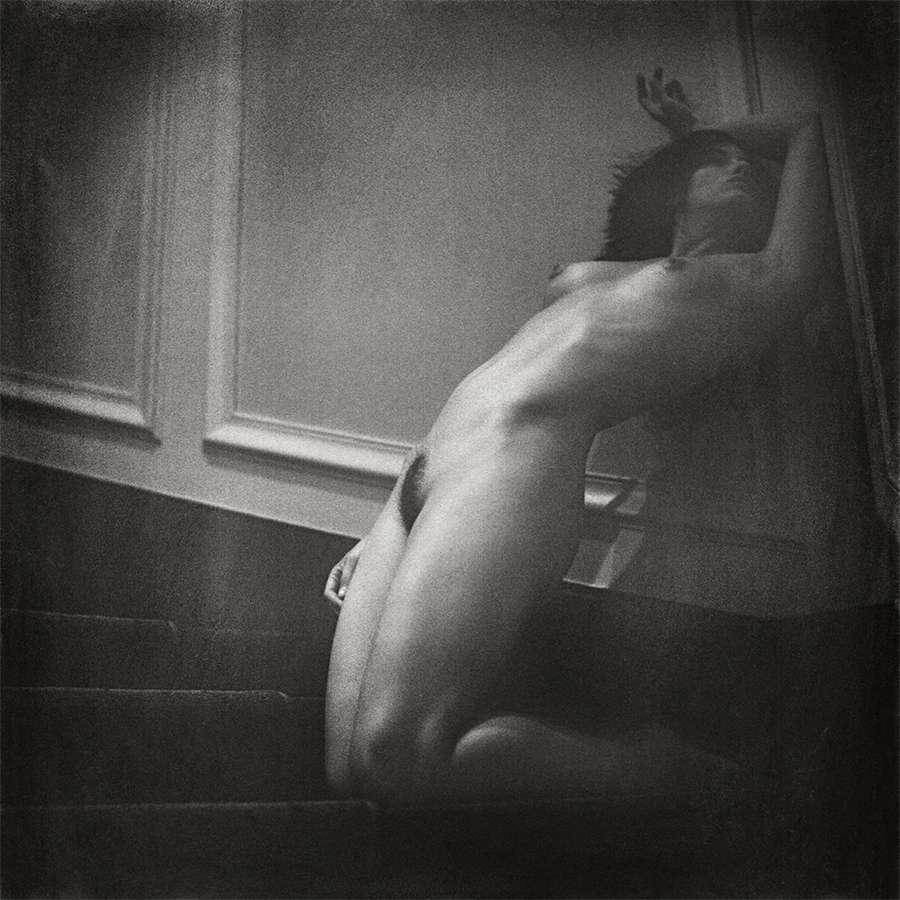
This time, that was exactly where I wanted to end up. I wanted the roughness. It matched what it felt like in that space, the heavy dark, the small slice of light catching skin, and the uncertainty in everything outside that little pocket of visibility.
Before I threw both rolls into it, I clipped a short test strip and gave it the full twenty minutes. I needed something physical to look at, not a guess.
And there it was. The atmosphere I’d been after.
So both rolls got twenty minutes each. I’ve never once wished I’d been more cautious.
The negatives came out with grain you could practically use as sandpaper. Getting that onto paper without losing the photograph, that was the next problem.
The difficult part
When I think back on it, the printing, not the shooting, not the development, was the part that really tested me.
I wanted the grain, sure, but wanting it doesn’t make it cooperative. Too much, and suddenly the whole print is only about grain. I had to find the spot where the roughness held the mood up instead of stealing the stage.
That mattered more to me than a neat, technically polite print. I wasn’t chasing corner sharpness or tidy little proofs of precision. What I wanted was to recognize the reason I’d made the photograph at all.
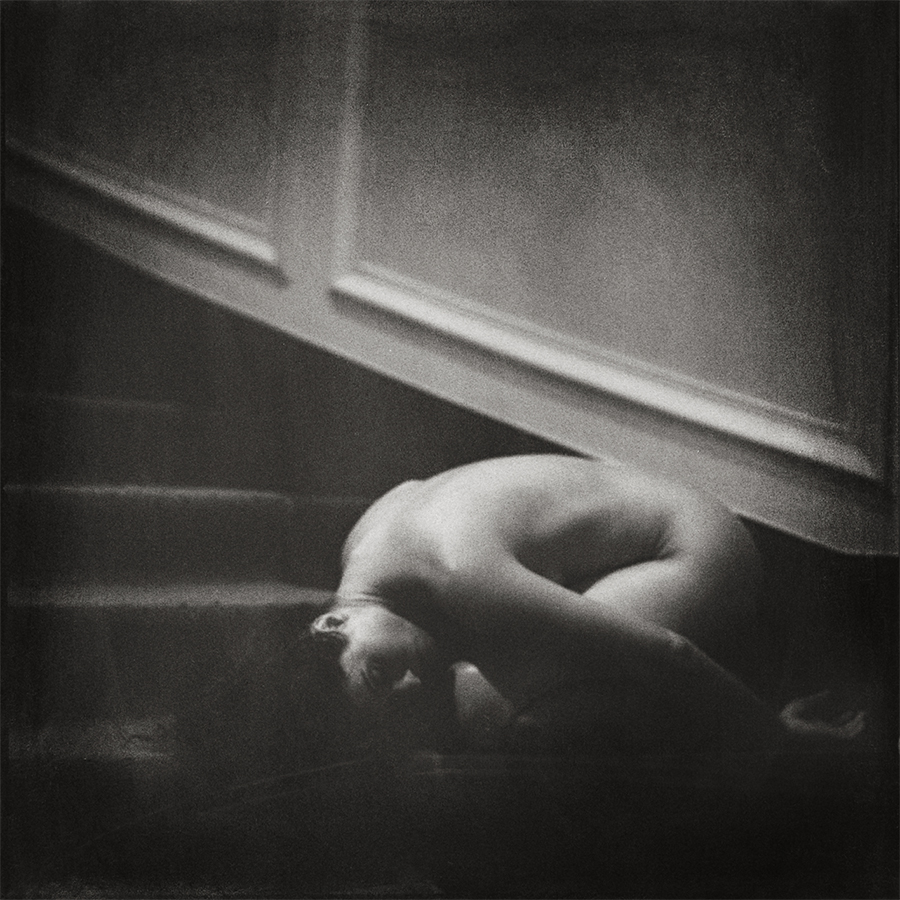
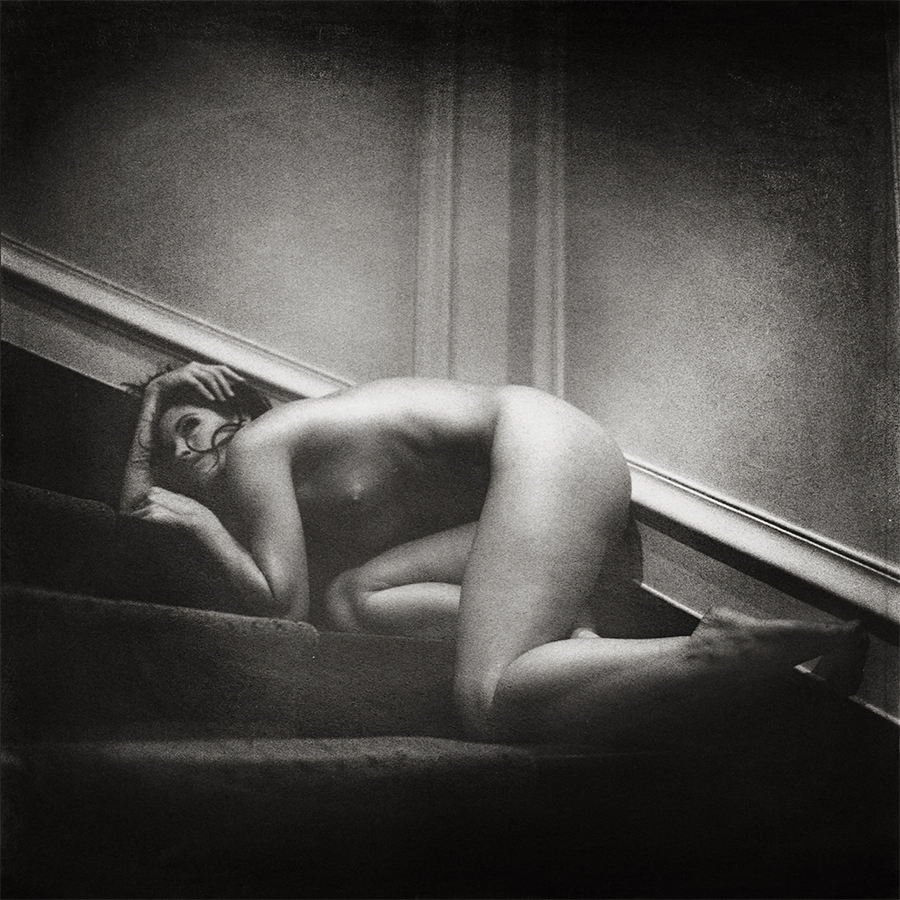
The staircase frame carries a lot of that for me. There’s a line of light along the back, light across the legs, a face close to the steps, a hand lifted above the head. The moulding cuts diagonally through the space. Then, beyond the obvious, the stairs and the body fade into places that make you slow down and look again.
I like that. Those darker parts give your mind somewhere to wander.
If I’d forced open every shadow, it would’ve become a different picture. I needed enough visibility for the gesture and the space to stay believable, but I didn’t need the hallway explained like a diagram. Some things were allowed to stay unfinished.
So printing turned into a hunt for relationships: how much exposure the figure needed, how loud the grain could be, and where the darkness should be allowed to keep its hold.
Finding the balance
Having the right gear made this a lot less punishing.
I printed on Poly Warmtone paper using a Durst Laborator 1200 with a multigrade head, plus the Heiland Splitgrade controller. The Splitgrade helped me pin down exposure and contrast and gave me a sensible starting point, which matters when the negatives are this stubborn.
It also made the local work easier, dodging here, holding back there, and keeping the balance across the print under control.
Even with measurements, the choices didn’t disappear. Numbers can tell you where you are, but they don’t tell you if the print actually carries the mood. I needed the grain to stay present without flattening the face, the gesture, or that thin bit of light that described the space.
That’s where the energy went. I’d already made the call with exposure and development. Now, at the enlarger, I had to make that call land on paper.
No pain, no gain, I guess. Though those negatives made a pretty good case for the pain side of the deal. 🙂
Out of the darkroom
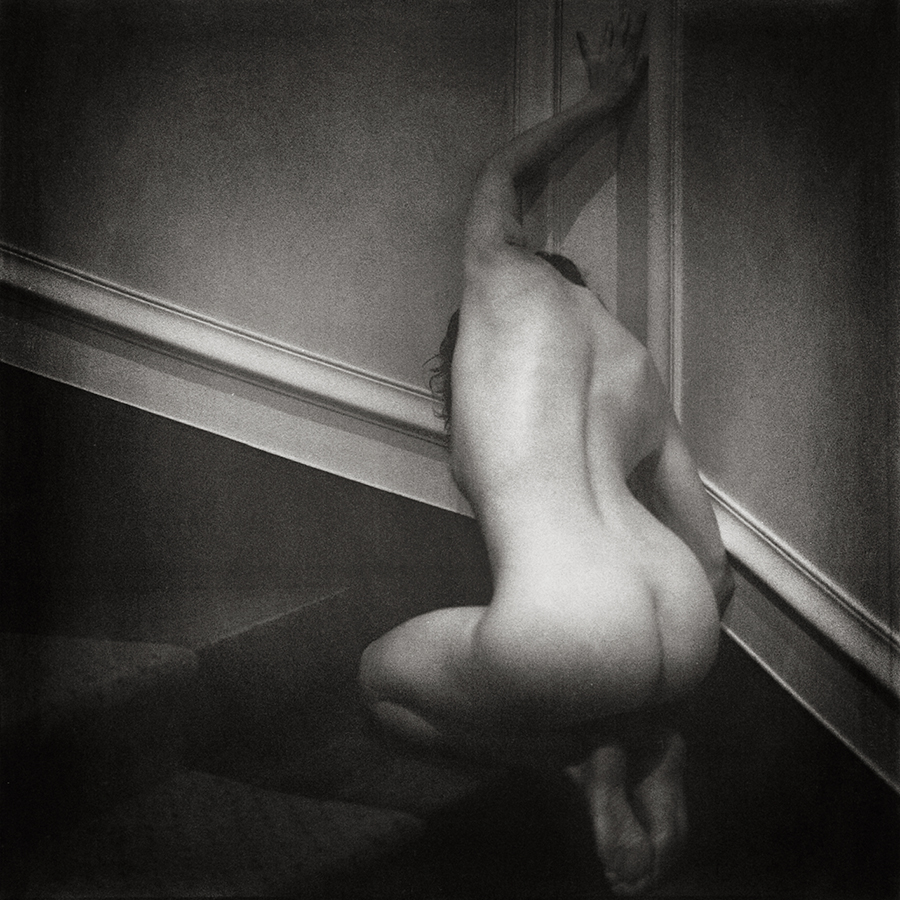
Once the prints were finished, they were scanned and reproduced at 120 × 120 cm for exhibitions.
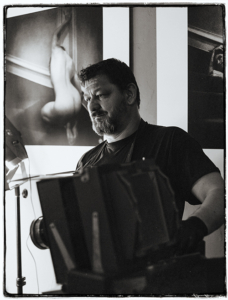 Those big reproductions came straight from the prints, so everything I’d wrestled into place at the enlarger traveled with them, the tonal balance, the local adjustments, the choice to let certain areas stay dark. The grain came along, too.
Seeing the work at that scale, I felt satisfied, and honestly, a bit relieved. The images held up the way I’d hoped. They looked at home in an exhibition setting, and they looked like they could live in someone’s house without me feeling like I’d sent something unfinished out into the world.
When I return to them now, I’m right back in that hallway, remembering how little light there was. I also remember what it took to print them. Choosing grain in development was the easy part. Living with it under the enlarger was the harder one.
But it gave me the feeling I’d been chasing.
And the shadows, in the end, kept a little piece for themselves.
Photographs: Vernon Trent
Model and Muse Collaborator: Candace

