
Medienhafen, framing it from memory
That day had one purpose, pinhole photos, nothing else.
Worldwide Pinhole Photography Day landed on Düsseldorf, so we took our cameras and wandered through the Medienhafen. The old harbour kept handing us scenes: sharp façades, odd bits jutting out, those tight gaps where buildings almost touch, and lines that kept rearranging themselves the moment you tilted your head up.
I went with the Holga 120 WPC because of the format. I wanted to see how that wide view would swallow the architecture, and what sort of version of it would come back to me once the film was developed.
Of course, there’s no viewfinder. You don’t “check,” you guess.
Three lines and a spirit level
The Holga does give you a hint, just not much. Up top there are three little marks, one aimed straight at the pinhole, two flaring out left and right. They more or less tell you what you’re getting horizontally. Up and down, though, you’re on your own.
Yes, there’s a spirit level. It can tell you if you’re straight, it can’t tell you where the building is going to end up inside the frame.
Some moments feel like moving through daylight with the confidence of someone in the dark. 🙂
Still, I’d already used this camera earlier that year in Domburg. Those negatives taught me, slowly, what the Holga “sees.” After looking at the prints, I started linking where I’d been standing to what showed up on the film, how far back was enough, what “too close” really meant.
I carried that lesson into the Medienhafen.
In a place like that, stepping back and forth to refine the framing isn’t always possible. You stand where you can stand, and from there you decide whether it fits. I thought it would, based on what the camera had shown me before.
When the film came back, it backed me up.
Fifteen seconds
Everything was on a tripod. Each frame was a fifteen-second exposure on Foma 200, shot under a solid overcast.
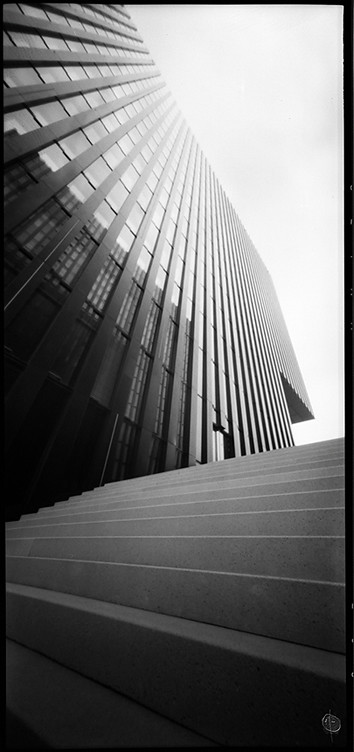
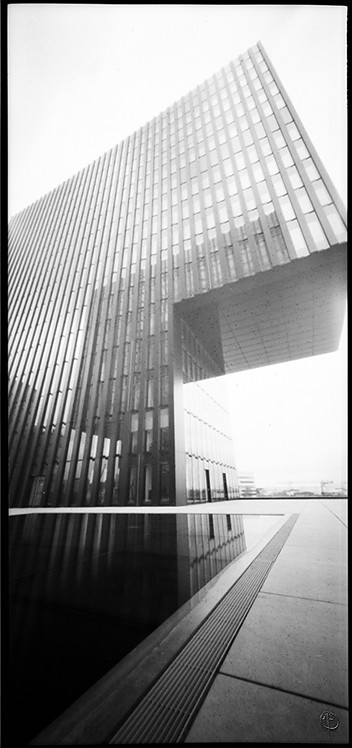
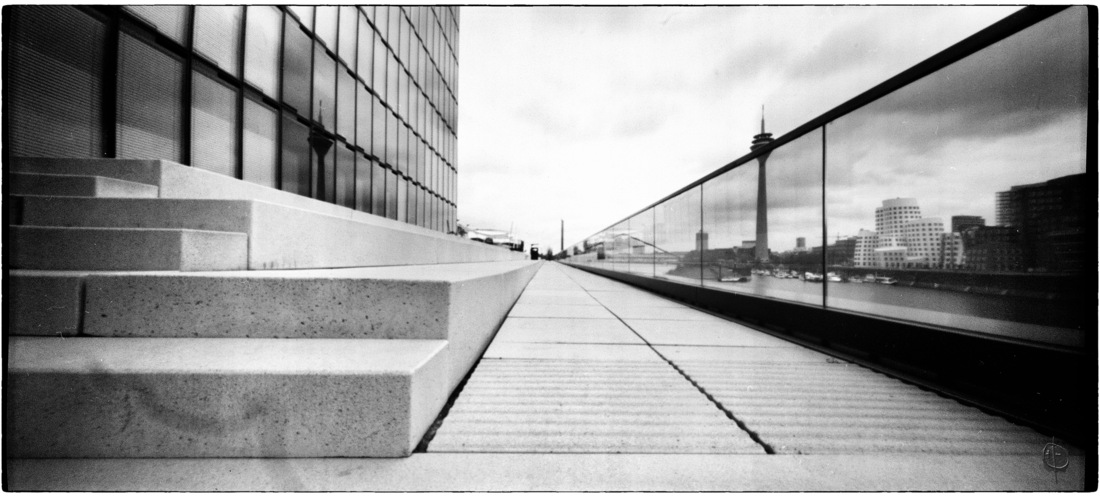
What I like in the results is the mix, clean architectural lines, but with the pinhole’s softer way of drawing. The steps and façades stay readable, yet the light gives the buildings a kind of weight that pulls me in beyond individual details.
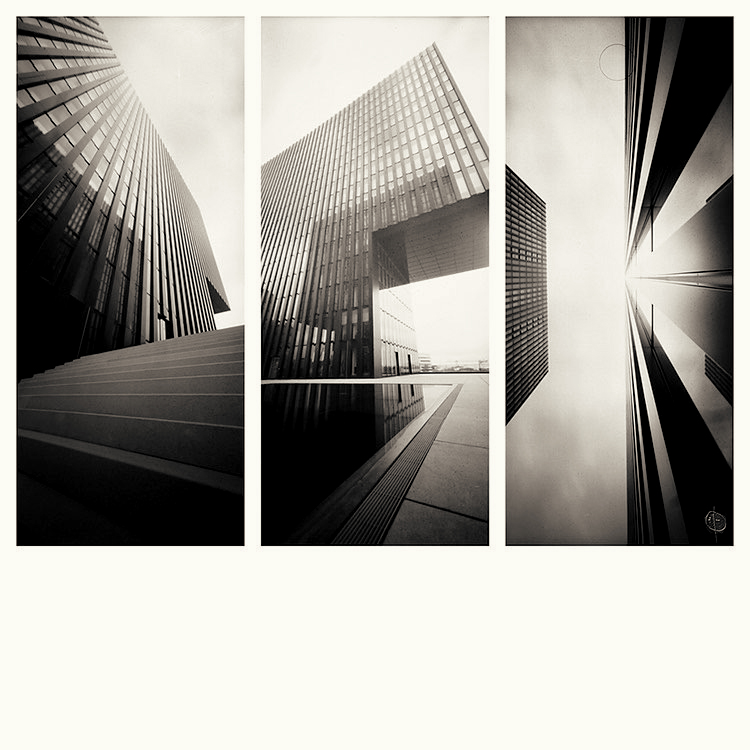
Across the three views, the same place shifts shape. In one shot, the façade lifts up from the stairs as if it’s sweeping. In another, a section that sticks out creates a bright pocket of space underneath. Looking upward, the buildings pinch in, guiding your eye to a narrow slice of sky.
I didn’t want them to live separately. I wanted them together.

One sheet, three exposures
So I printed the triptych onto a single sheet of photographic paper.
First came a cardboard mask, cut by hand, then laid over the enlarger easel. That set the three windows and the thin gaps between them. With each negative, I shifted the easel carefully so the next exposure landed exactly where it was supposed to.
That placement had to stay steady the whole time. One small bump, a tiny accidental slide of the mask or the easel, and the alignment could be ruined after part of the sheet was already exposed.
Every panel got the same printing time.
When I print each image on its own, the tones match nicely. On the shared sheet, the middle photo keeps a brighter patch toward the centre-right. I was fine with it. The scale still holds, and the triptych still reads the way I wanted.
There were also plain practical limits. While swapping negatives and nudging the easel into position, the paper sat under the safelight. Safelight isn’t magic, it still runs out of “safe” if you leave paper under it too long, and fog starts creeping in.
And once the alignment felt right, I didn’t want to keep touching things. Every extra adjustment is another chance to move the one thing you absolutely need to stay put.
The mask was simple. Getting three exposures onto one sheet without drifting took attention.
Looking at the whole
What mattered most wasn’t any single frame, it was how the three sat together on the finished sheet.
Those narrow white breaks keep each view separate, but the repeated lines carry your eye across the set. The bigger margin at the bottom gives the arrangement a bit of breathing room. And that small tonal difference in the middle panel doesn’t interrupt the relationship for me.
Making it came down to two kinds of judgement. Out in the harbour, I trusted what earlier Holga photos had taught me about framing without a viewfinder. Back in the darkroom, I worked carefully enough to put the three prints on one sheet, then stepped back and decided whether it all held the feeling I was after.
It did.

*Making notes: Düsseldorf Medienhafen, photographed during a Worldwide Pinhole Photography Day walk. Holga 120 WPC, Foma 200, tripod, fifteen-second exposures. Triptych printed as three separate exposures onto one sheet of AGFA MCC photographic paper, using a handmade cardboard mask, same exposure time for each panel. Moersch SE4 Dev and Moersch Variotoner *

