
Coffee klatch, twelve seconds, and a bit of making-it-up-as-we-go
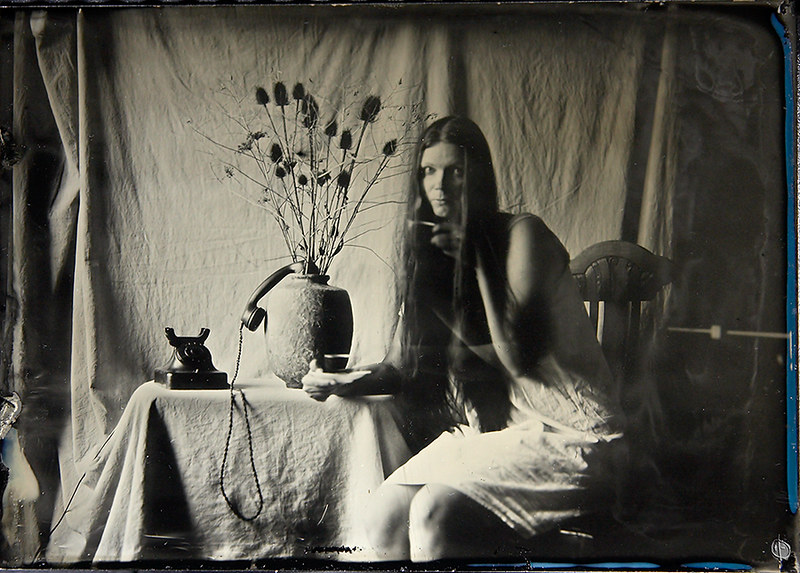
What showed up first, in my head, wasn’t the process at all. It was the little set, a table dressed in cloth, a vase with dried stems, an old telephone with the receiver propped against the vase. Mrs. Hyde sitting right there beside it, cup in hand.
Back then I was only just getting my feet under me with wetplate collodion, still trying to get a feel for the whole strange rhythm of it. Coating plates, keeping them clean, reading the light, then somehow surviving the wet part without turning everything into a sticky disaster.
The studio didn’t really know what I was about to ask of it, and if I’m honest, neither did I. I’d hauled this process into the room before I’d fully grasped what the room needed to give back. So the day turned into pure improvisation.
A temporary darkroom
We ended up drafting the studio restroom into service. That became the wet-work zone where I poured, sensitized, and developed, while the camera sat out in the main space with the natural light.
Wetplate forces you to move fast and move carefully. You’re going back and forth, chemistry in play, a plate in your hands, and a picture to make before the clock runs out and everything dries on you.
And the light, of course, wouldn’t sit still for me. Daylight kept shifting, and I kept guessing, then guessing again. At that point I didn’t have much experience to lean on, every plate was another lesson delivered the hard way.
The studio also wasn’t exactly built for chemical Armageddon, so along with everything else I was trying to keep the mess contained.
The next day I noticed thin black flecks on the floor, like a breadcrumb trail from restroom to camera. Silver nitrate. Turns out I’d documented my walking route, too.
Something to do with twelve seconds
“Coffee klatch” was made on a 5×7 aluminium plate, with a Russian FDK camera and an Industar 210 mm f/4.5 lens.
For this one I landed on a twelve-second exposure.
Once the set was arranged and Mrs. Hyde was settled, a thought hit me. Twelve seconds is long enough for something to happen inside the frame, if we were brave enough to try it. I asked her to move the hand holding the cup when I gave her a cue.
So we staged it inside the exposure. For about the first half she held steady. Then, on my signal, she shifted slowly, taking around three seconds to reach the new position, and she stayed there for the last few seconds.
It was a gamble. My hope was that the still moments would register as two readable positions, and I honestly had no clear idea what the in-between motion would do.
She had to do a lot: hold the pose, listen, move gently, settle again, all while time kept running. Her timing mattered just as much as mine.
We did a single take.
More than I expected
When the plate came up in development, the surprise wasn’t the pose, it was the motion.
I’d been thinking in terms of those two held positions, but even that slow transition showed itself. With the low sensitivity I was working with, roughly ISO 1–2 territory, I wasn’t sure the brief movement would leave much behind.
But it did. More than I expected.
If you look at the hand and cup, you can actually trace a small event unfolding in the middle of an otherwise locked-down still life. The telephone, the vase, the dried stems, the draped cloth, they stay put. And next to them, the cup has clearly gone somewhere.
I’d called the action, sure. Still, seeing what the plate decided to keep was a different thing entirely. At that stage I was learning, in real time, what the process would do with my choices.
This time it handed me something I wanted to hold onto.
One try was enough. I was also getting low on materials, and aluminium sheets weren’t cheap. There wasn’t some bottomless stack waiting for “take two” and “take three.” I had a plate that startled me in a good way, and I left it there.
Operator not available
Later on I photographed the setup again, only without Mrs. Hyde.
The table, the telephone, the vase, all still there. Yet without her, that empty space beside them suddenly became the loudest part of the picture. The receiver stayed off the hook, the cord dropping over the cloth.
That image is up on XoverIP as “… operator not available.”
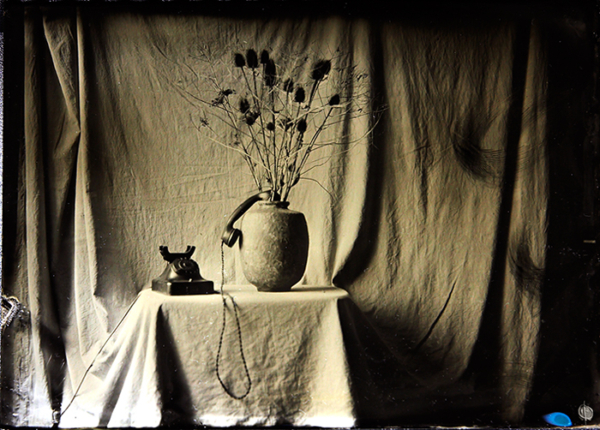
Maybe the coffee was stronger than it looked. 🙂
Looking at the pair now, what comes back is how much of that day we were solving on the fly, the wandering light, the exposure guesses, the restroom darkroom, the awkward dance of unfamiliar chemistry in a room meant for something else.
And I keep thinking about that moment where I asked her to move the cup, without really knowing what we’d end up with.
Twelve seconds, one slow gesture, and a plate that still carries the surprise.
—
*Making notes: “Coffee klatch,” featuring Mrs. Hyde. Wetplate collodion on a 5×7 aluminium substrate; Russian FDK camera; Industar 210 mm f/4.5 lens; twelve-second exposure. Hand movement deliberately cued during the exposure.*

