Archive for category: Field Note

Quite a Few Euros Later

For a while I had an entire little fleet of it in different shapes and sizes, 600, TZ, Land pack film, 4×5 Type 55. I poured quite a few euros into that stash. Still, I told myself it was cheaper than a Modelleisenbahn, and I’ve stuck to that story because it’s easier that way.

Some of the packs were ridiculous, more than fifteen years past the date stamped on the box. And yet, most of them still came through. Every time I tore one open, it was a gamble, you got to find out what it had left in it, if anything, and I liked not knowing. One sheet would come out almost pristine, another would arrive with scuffs, a cloudy patch, a colour shift that nudged the whole picture into unfamiliar territory.
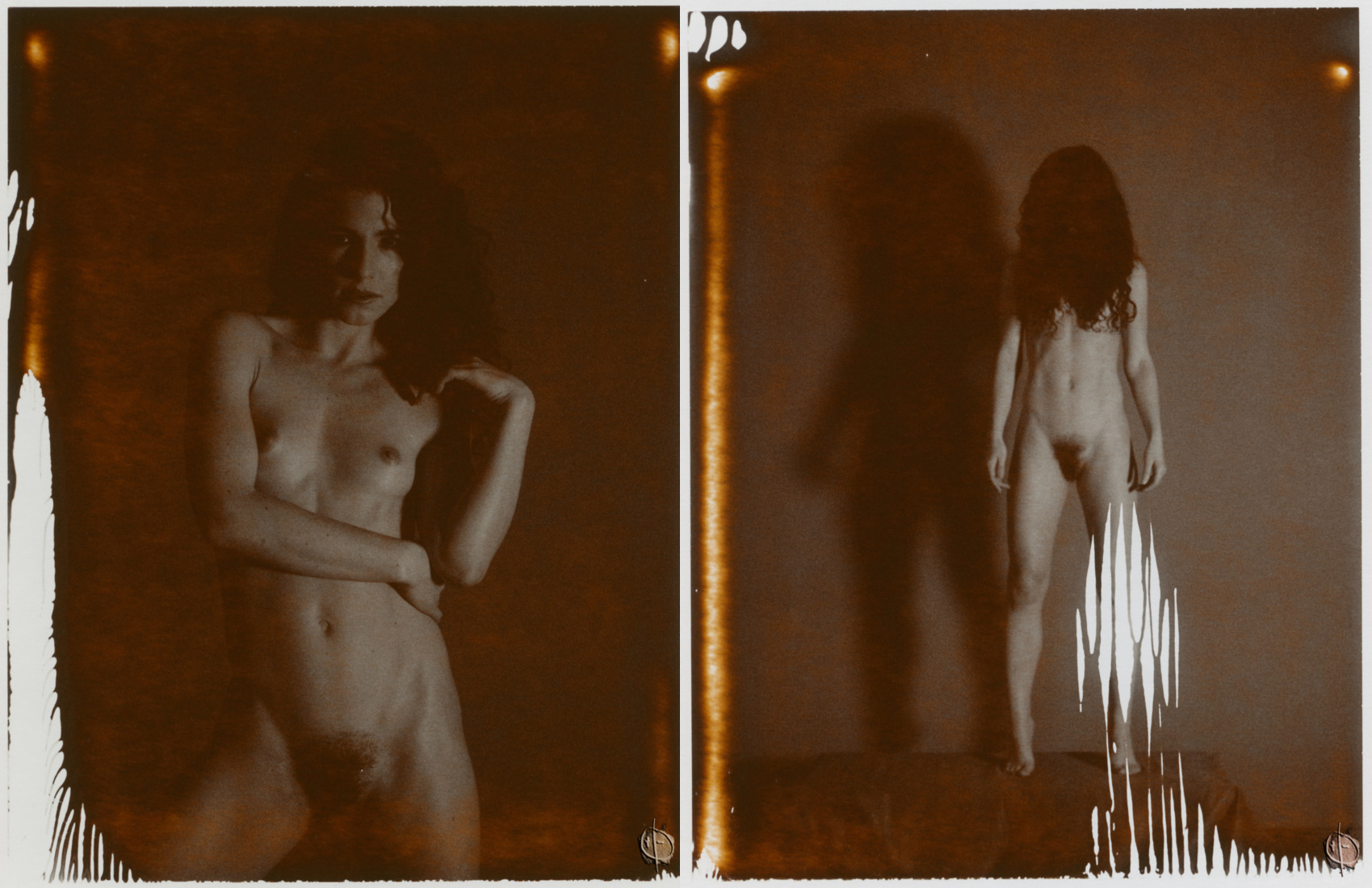
Half the time, those “flaws” felt like gifts. A colour I’d never have picked showed up anyway and suddenly it belonged. A strange artefact would slice through a smooth area and, somehow, the image looked more itself because of it. When it worked, it didn’t just work, it carried the stamp of that exact exposure, that single sheet, that aging pack I’d taken a chance on.

And yes, sometimes it just failed. There was always the option of expensive disappointment.
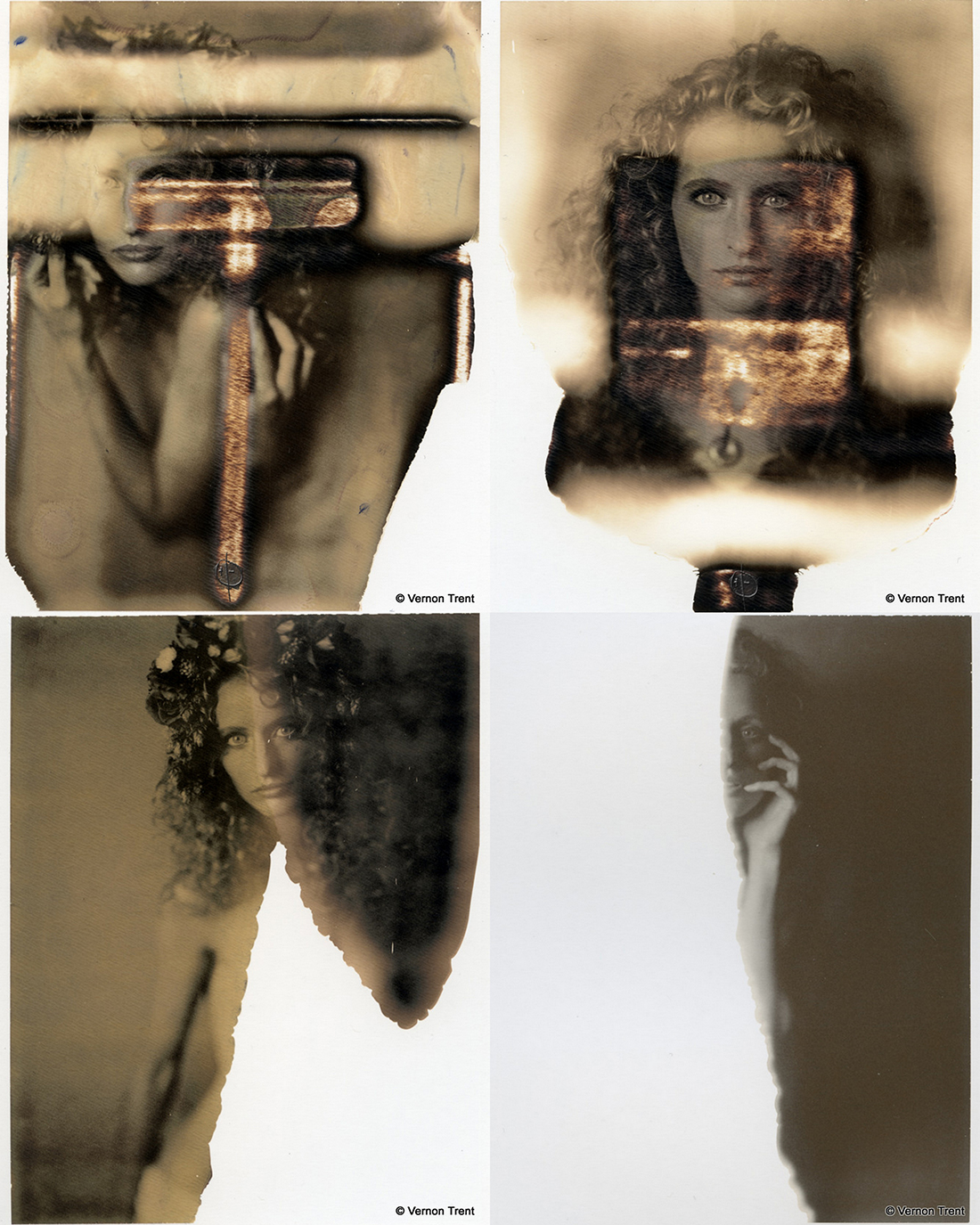
Still I went back, again and again.

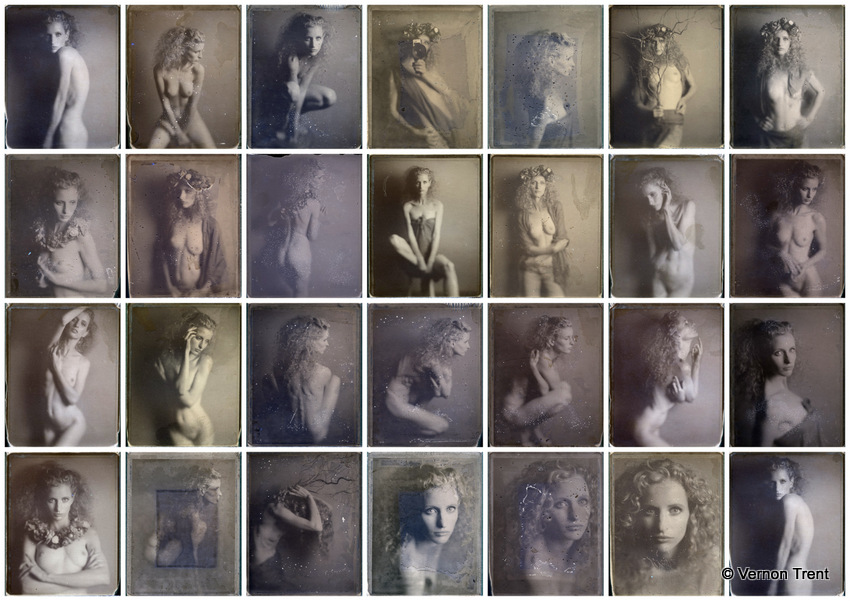
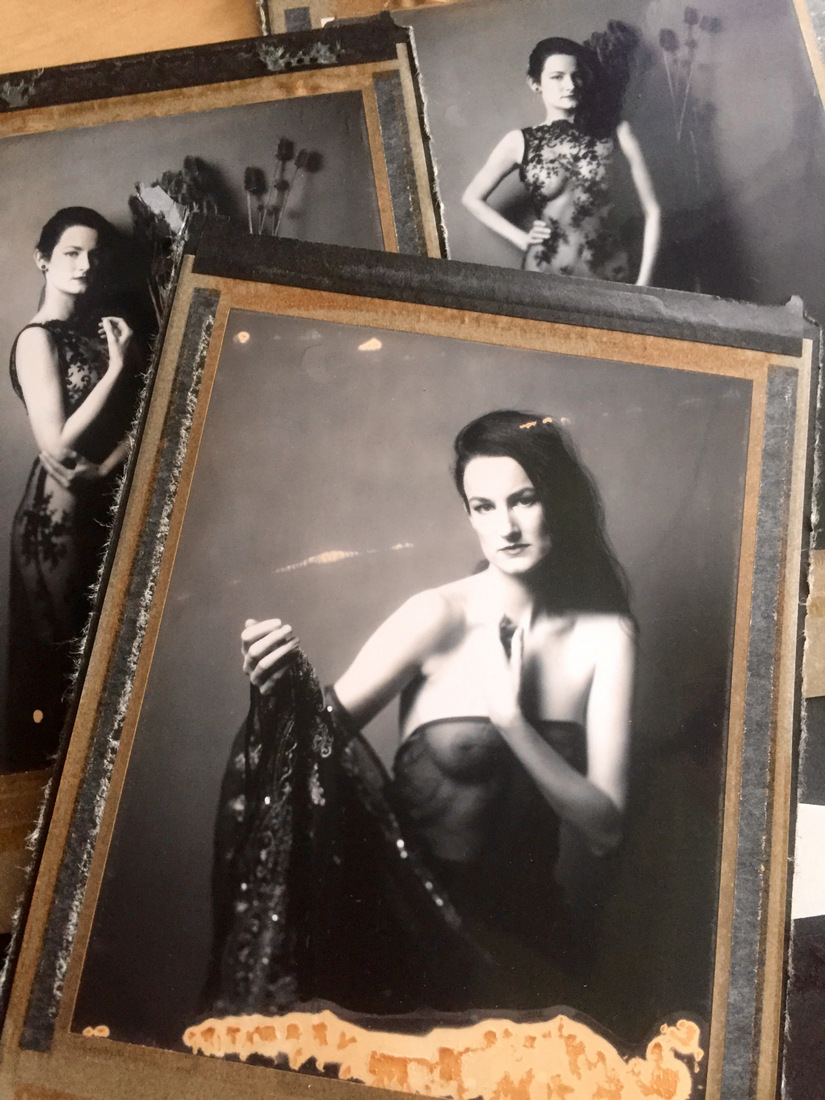
When I look at those photographs now, the pleasure comes back, and with it a sharper little ache. Some modern polaroid films today try to brush against that same mood, that aura, but the feeling isn’t the same. It’s not only about colour, it’s harder than that. There was a softness to it, a particular way light and skin landed, and always that sense that the film might decide to add something of its own.
I could work with that. I liked watching it happen.

Even the peel-apart leftovers sometimes earned their place in the archive. Some films that didn’t provide a usable negative still left an image on the sheet I peeled away. I kept those sheets, scanned them and used them to make digital negatives. Some had more tension and mood than the photograph I was supposed to keep.

After spending all those euros on film, it was reassuring to discover that even the leftovers could pull their weight.
The 4×5 format was the one I loved most, especially when it handed me a negative along with the instant print. That extra sheet, it felt like a door opening. I could print from it again later, or scan it and keep pushing, right up to a digital negative around 40×50 centimetres.
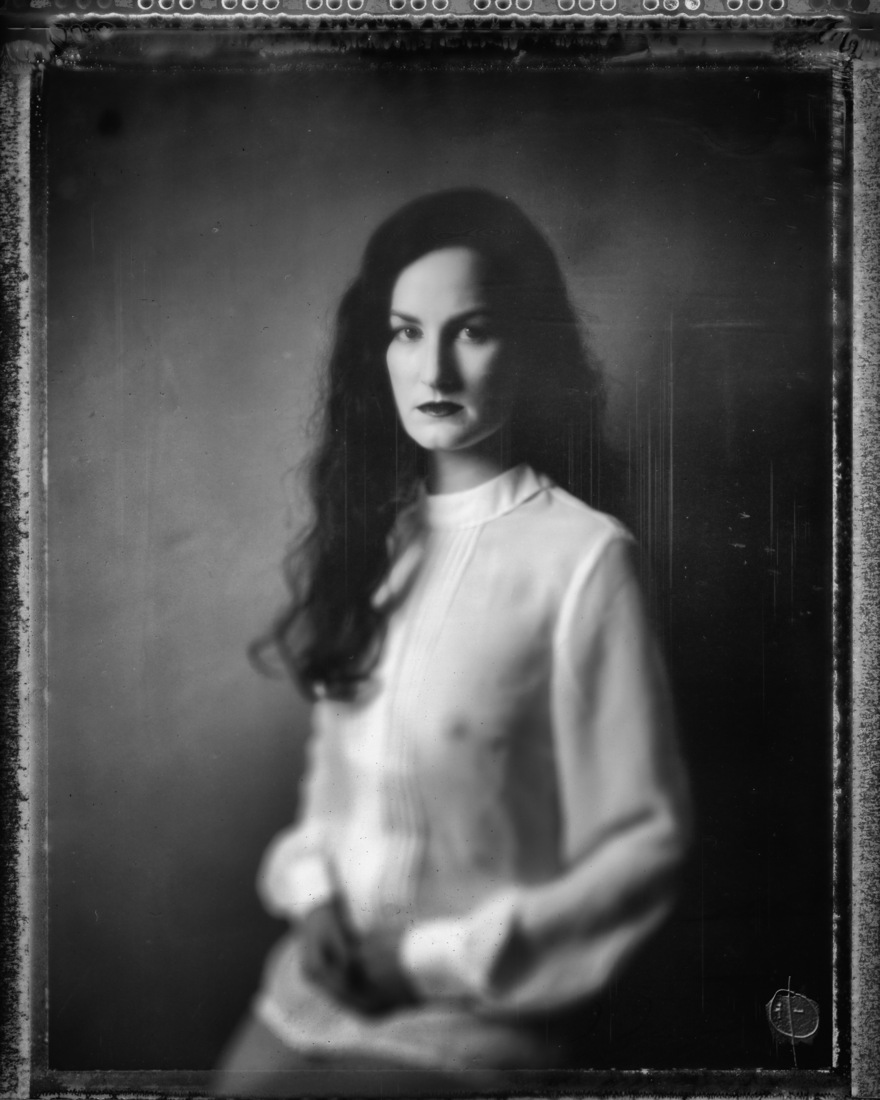
 

The small picture could grow into something much bigger and still keep its softness, keep its marks. A tiny trace that barely registered in the original would start speaking louder at that scale. I wanted those qualities to travel with the image, not to get cleaned away, because they were part of what pulled me in to begin with.

And the negative itself was something I could actually build on.

For the portrait with wings, I added another layer using transparent paper. I made a sandwich of it, wings and negative pressed together. Simple enough as an idea, but it gave me another way forward, working with what was physically there, stacking pieces, adjusting them, seeing how they settled into a single image.
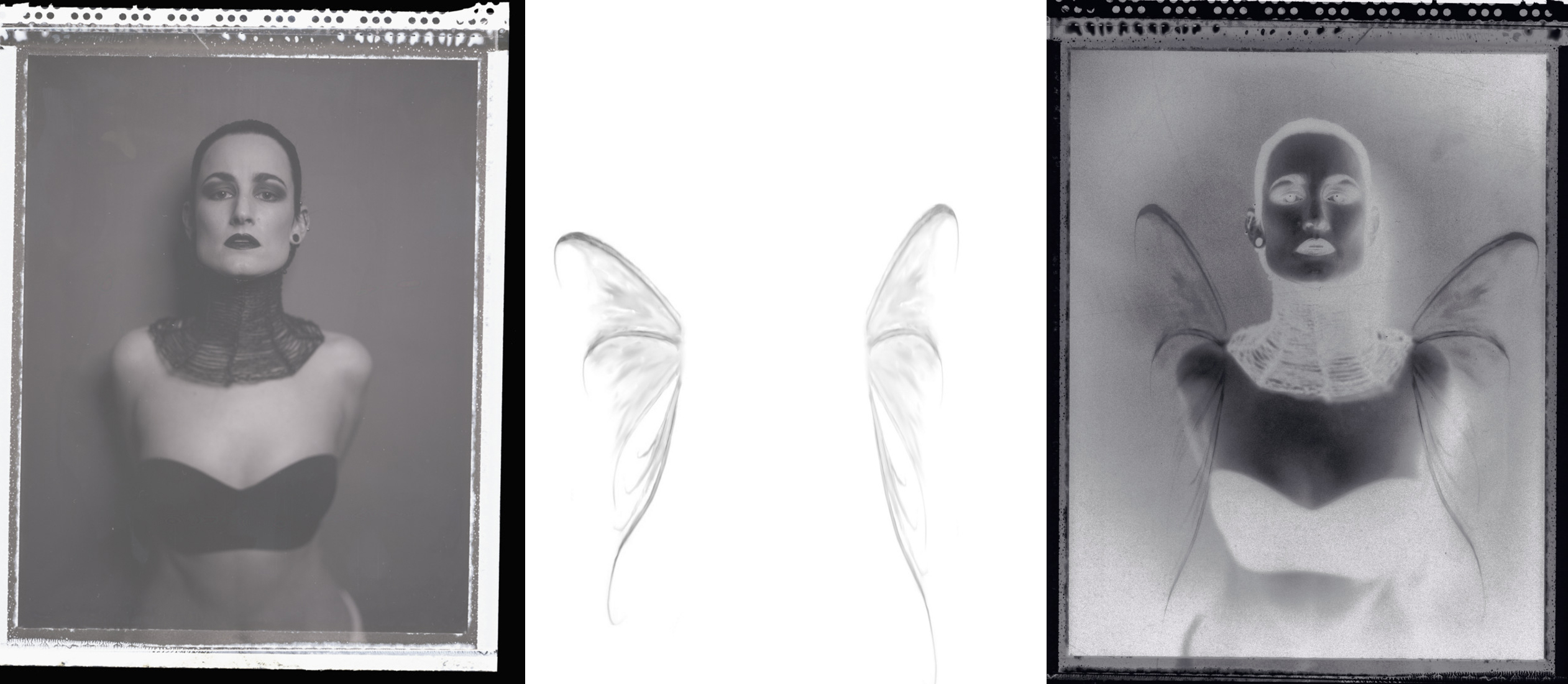
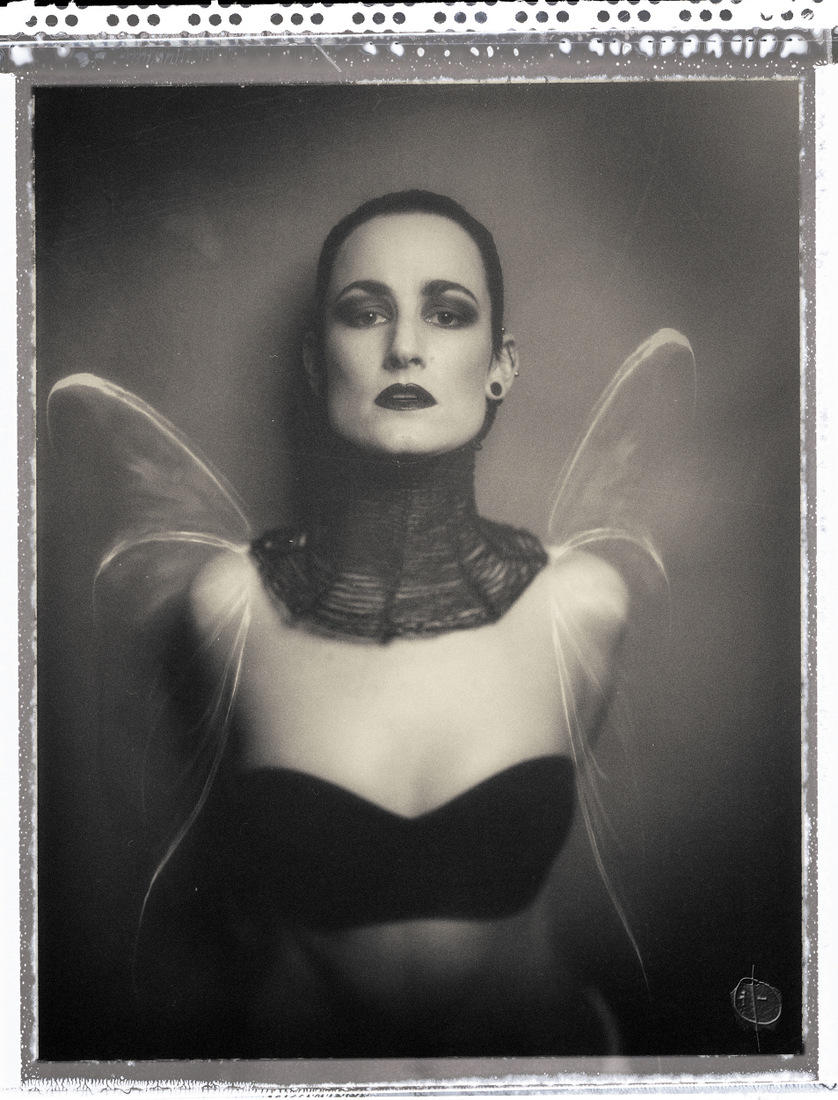
 

That kind of freedom was a huge part of the draw. There were different moments where you could choose to keep going, and more than one route for doing it.

With 600 film, I got a lot of joy out of lifting the emulsion and moving it onto paper. First you cut away the Polaroid edges, then peel off the protective layer, then into hot water it goes until the image finally lets go of its carrier.
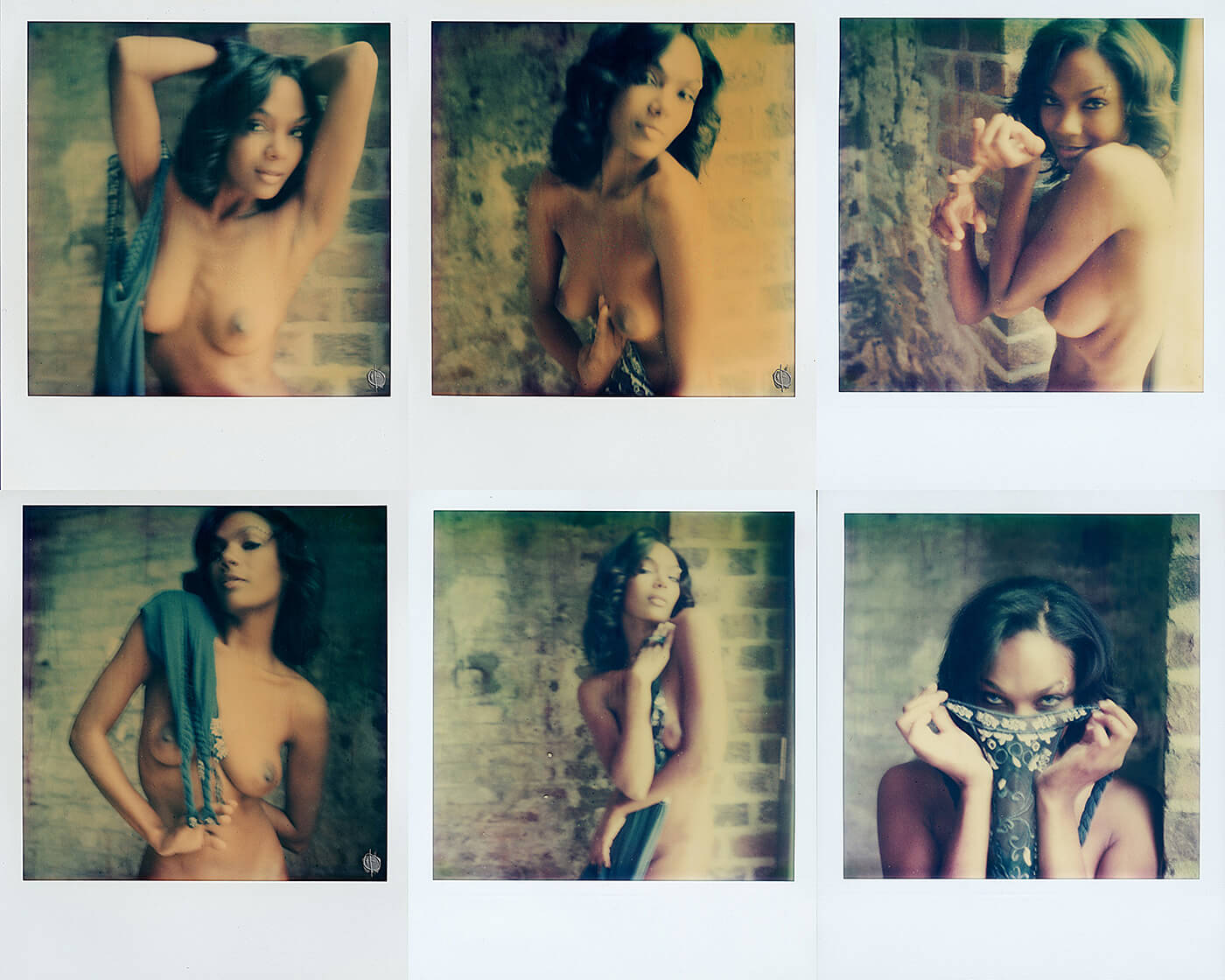
After that came the fiddling.

I’d slide a sheet of paper under the floating skin of the image, coax it across, then use a brush to nudge it into place. It was unbelievably thin, and suddenly everything depended on being gentle. To get it exactly where I wanted it took patience, and a lot of tiny corrections that didn’t look like much until they did.

I had so much fun with it.

Because after the composing and the exposure, there I was making decisions again, only now with wet paper and a brush. The photograph had turned into something I could move around, arrange by hand. It was such a satisfying way to spend time with an image.

I don’t have any of my own transfers anymore. They’ve all been sold, scattered off into other homes. What I do have is one made by a friend, a photograph of me with my atelier camera, transferred with the same method. I’m glad I’ve got it, especially now, when my own examples live somewhere else.
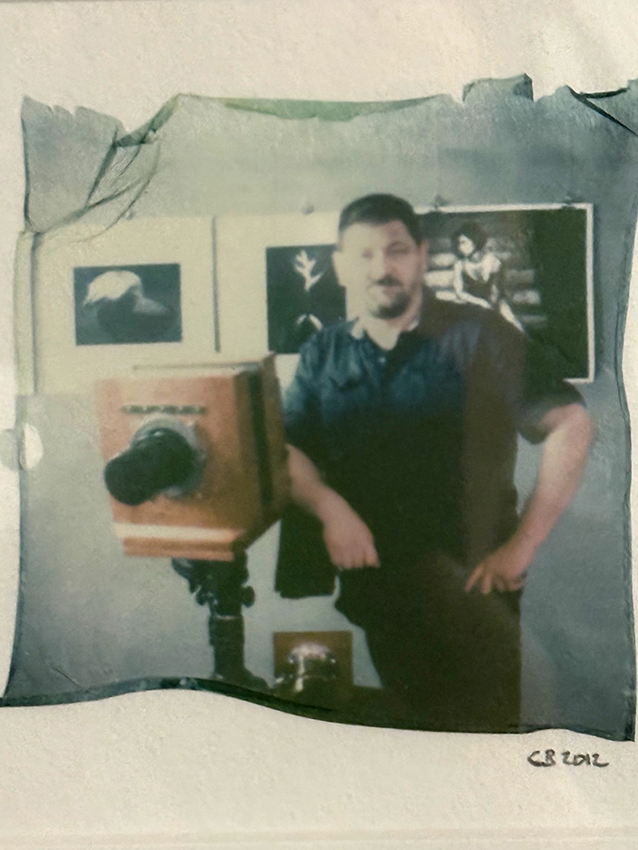
emulsion transfer made by Christian Baron (https://christianbaron.com/)

There was good work in it, and there was real pleasure in getting there.

Those Polaroid years were a small, bright pocket of my working life, special, and wildly entertaining.
When I flip through the photos now, it’s all there again, the old packs, the surprise colours, the awkward little transfers, and that quiet thrill of seeing just how far an image could be pushed.
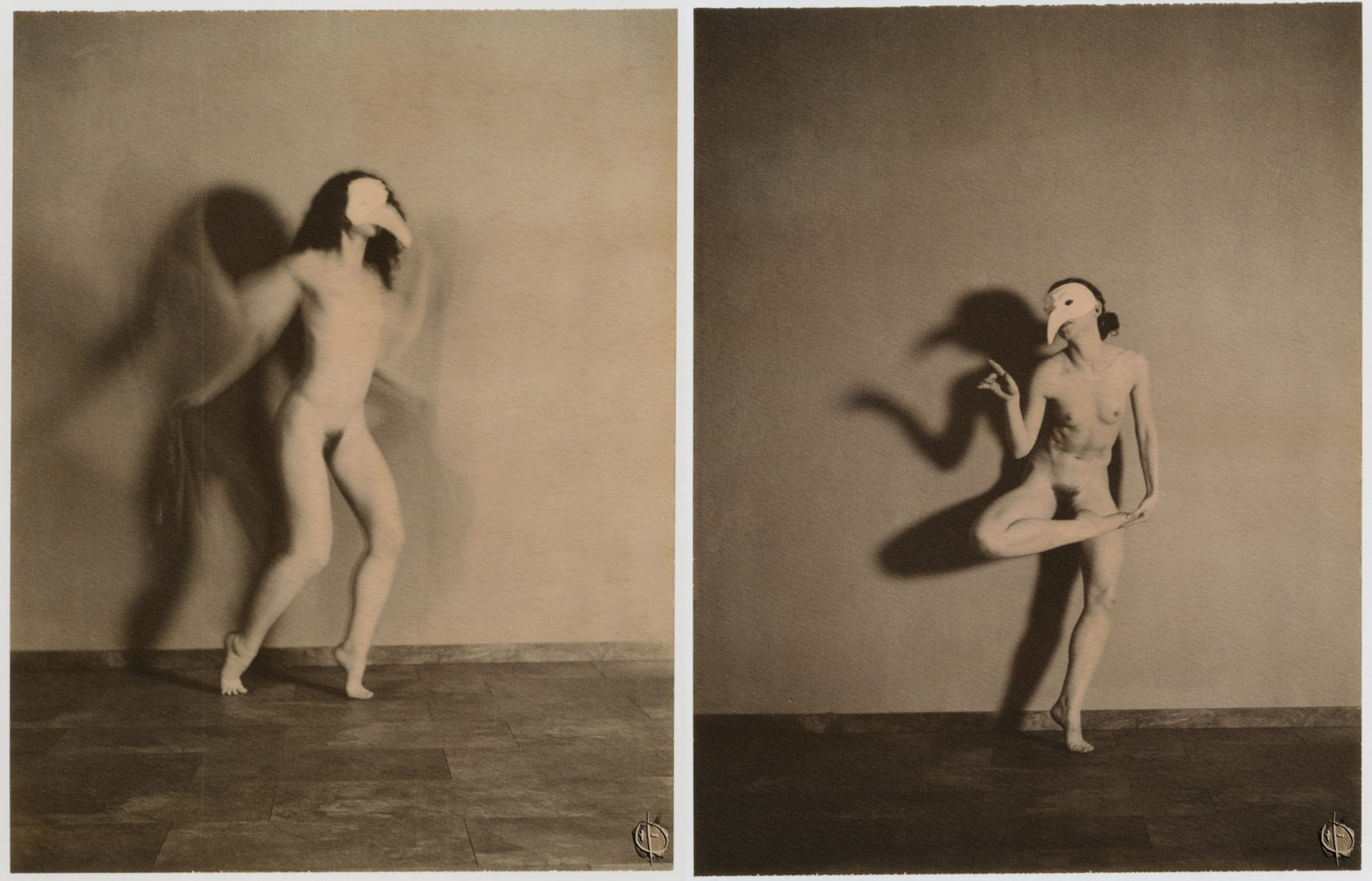

I poured a fair few euros into it. I had a huge amount of fun, made pieces that ended up hanging in other people’s homes, and walked away with some very good memories.

And still, cheaper than a Modelleisenbahn.
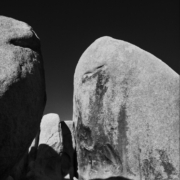
Within Reach

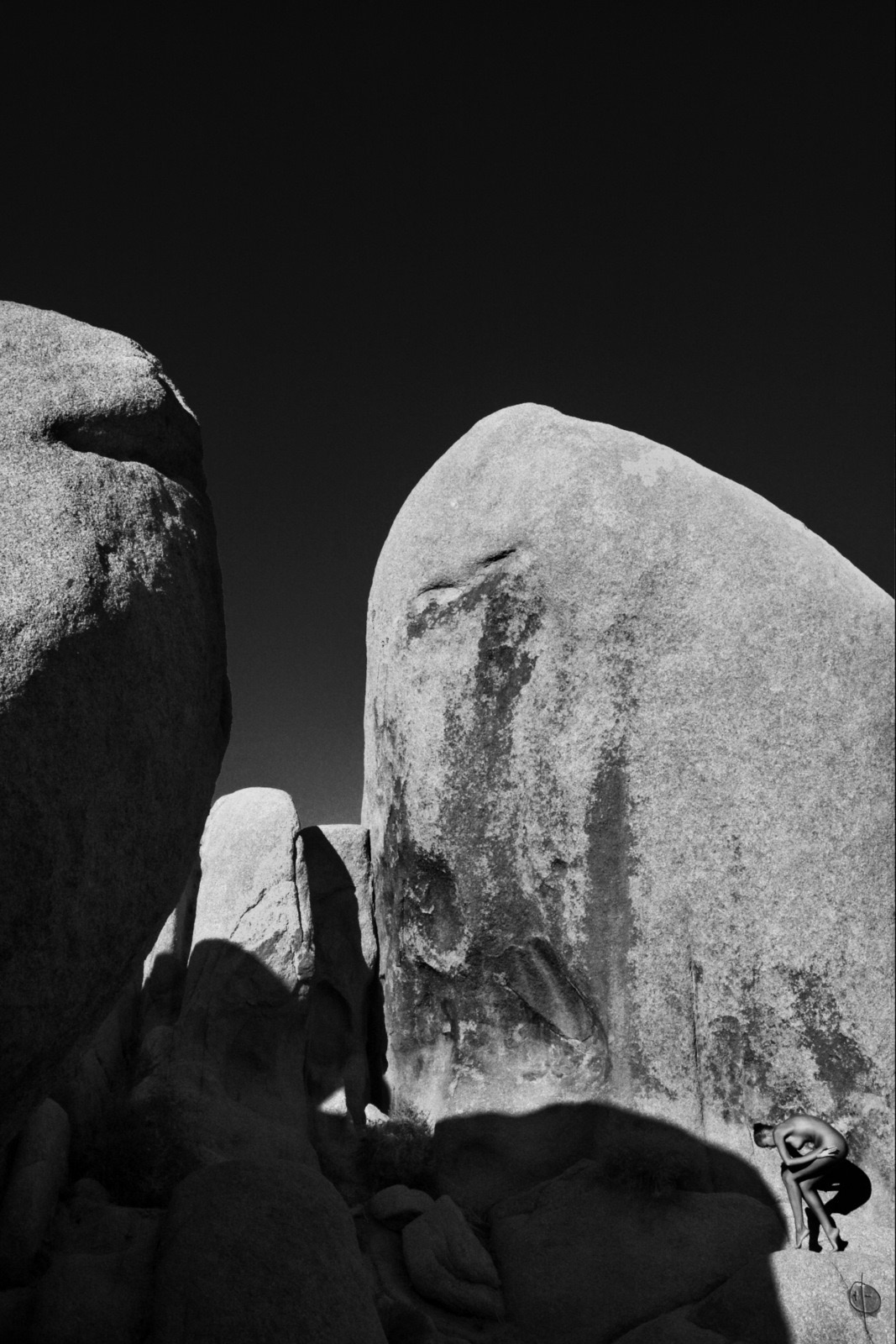
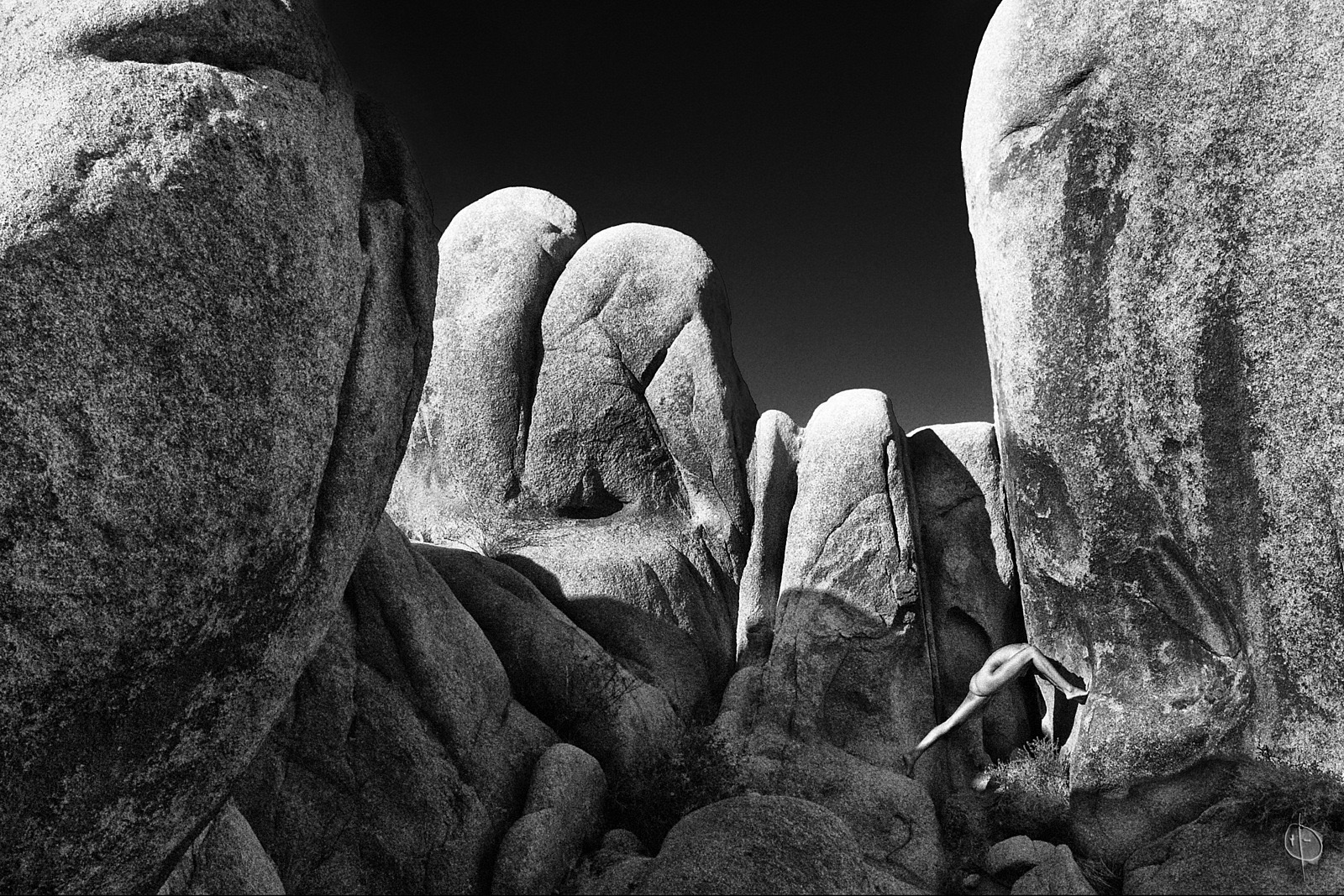
I met Kat through my camera in Joshua Tree National Park.

There was room to breathe out there, big boulders, long pockets of shade, the sky opened up wide, and Kat quietly settling herself into it all. In some frames she’s almost an afterthought in terms of scale, just a small figure against all that geology, yet I kept circling back to her. The lift of an arm. A slight twist through the shoulders. The exact way she planted her feet. Tiny choices, and suddenly she wasn’t swallowed by the stone at all.

That’s where it first clicked for me, what this woman could do.

Kat is tall… six foot two, but out there that fact stops being the headline. The photograph hangs on something else, her sense of where she is, and what she’s bringing into the space.

She can echo the line of a rock, let a gesture travel across an empty gap, or draw herself inward until she fits a tight pocket of shade. It’s never just posing beside a landscape, it’s more like the body negotiating with it. Watching her, I started paying closer attention to everything, her decisions, yes, but also the shapes around her that I’d normally rush past.

Photographing someone whose ideas arrive through motion has its own kind of joy. You put down a simple starting point, and then the next thing appears, something you didn’t know to ask for, something you couldn’t have scripted.

Kat has that in her. She’s a terrific figure model, and also simply a good, solid person. Both of those truths sit inside these sessions. The pictures carry her judgement and her inventiveness, and when I think back on making them, what rises up too is how warm it felt to work with her.
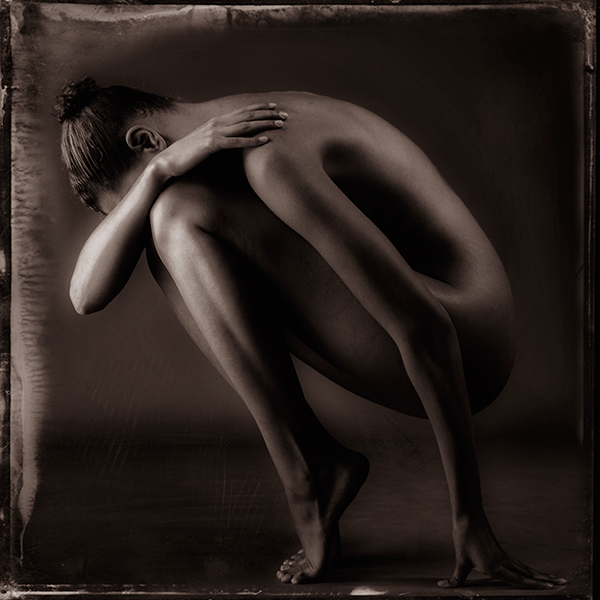
On our second session, the world tightened in.

*From our second session together.*

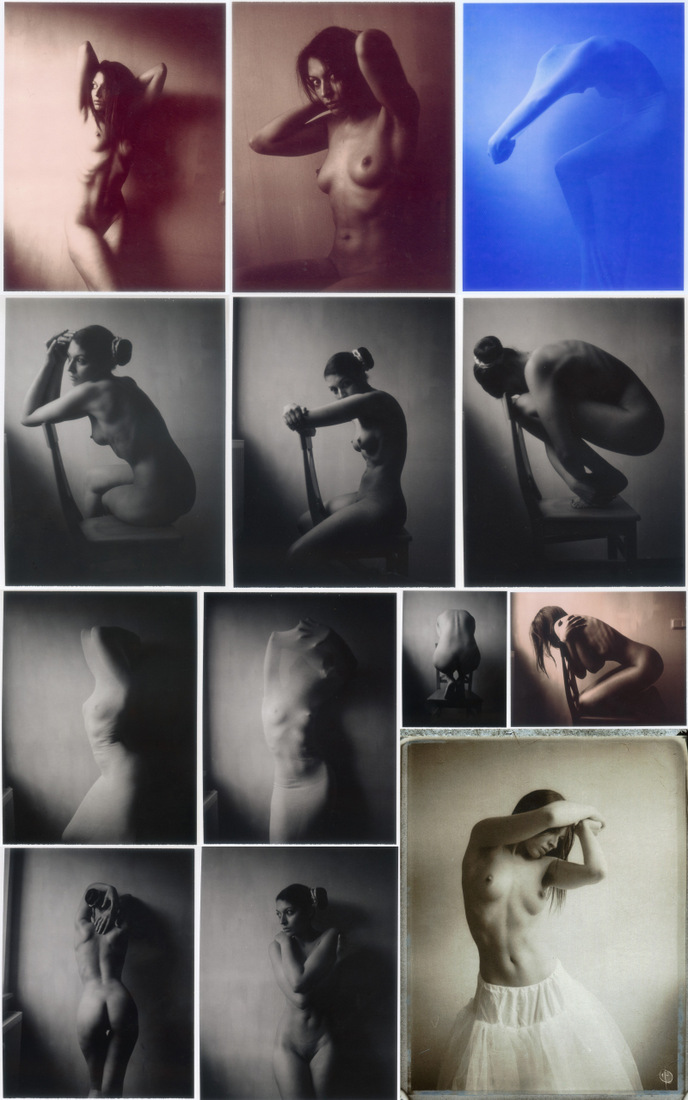
Here she takes that tall frame of hers and folds it down into something compact. One hand crosses to the shoulder, the head dips toward the knees, the other hand finds the floor and closes the loop. It’s all there, contained.

What I loved was how fully she could live inside a frame. Even pulled in close like this, the pose still breathes, little gaps between limbs, a curve the light can travel, a gesture that feels finished, like it knows exactly what it is.

I’d recognise that same awareness again once we brought in the chair.

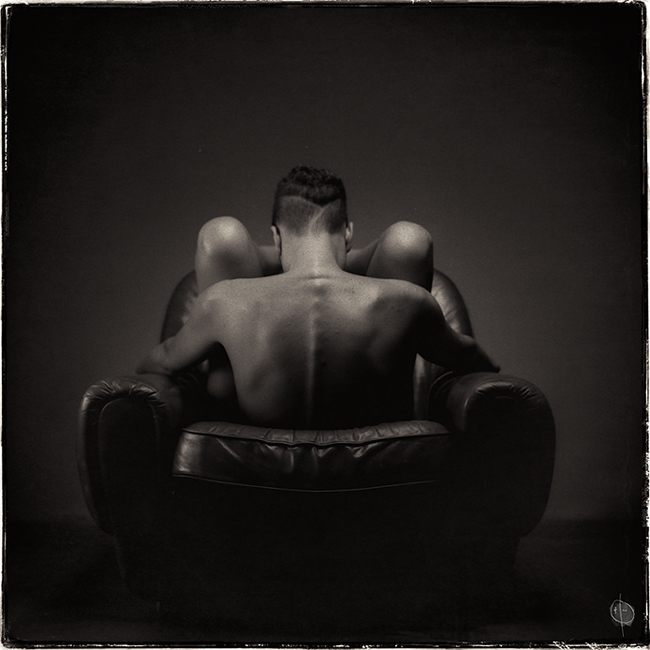
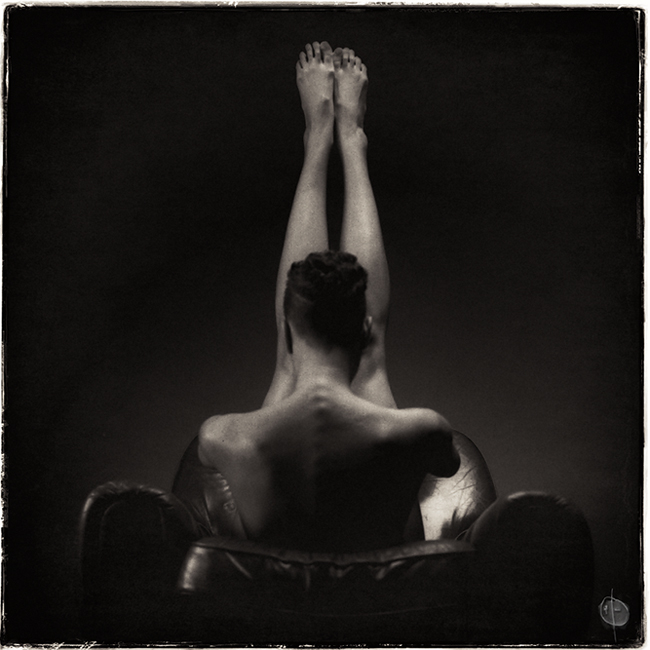
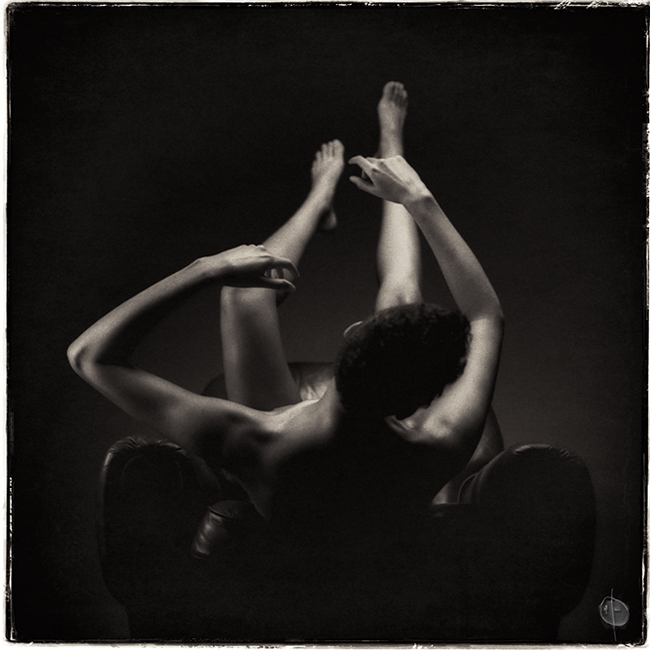
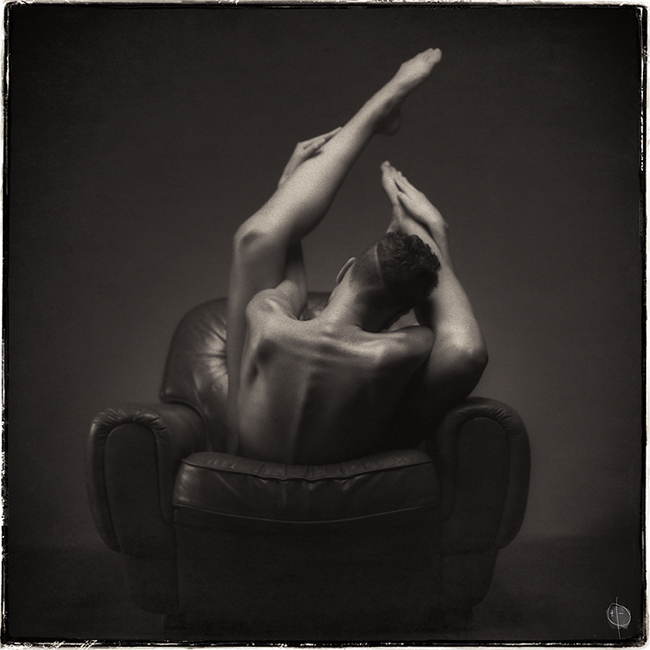
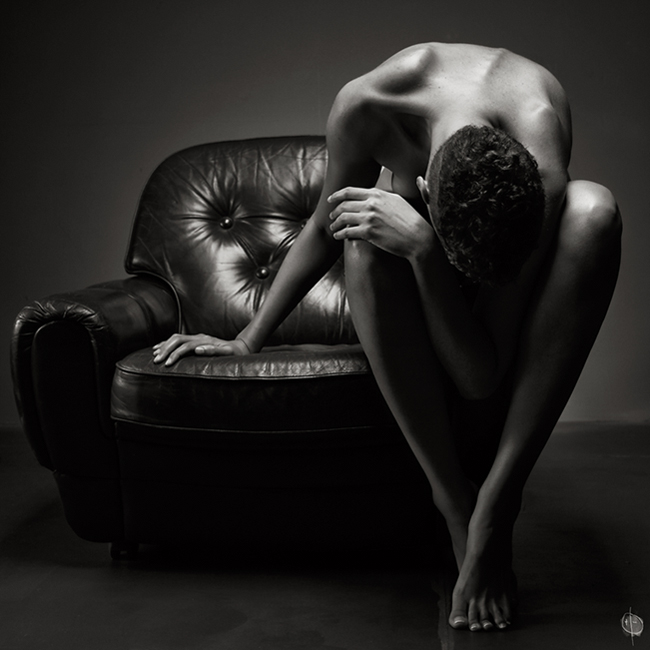
The arrangement was straightforward, a lightbox overhead, an armchair, and, naturally, Kat.

I had the Hasselblad, my old friend, plus Rollei R3 shot at EI 400. This time we weren’t starved for light. Familiar gear in my hands, and someone in front of me who kept opening doors I hadn’t noticed yet.

Like a lot of my shoots, it started with a thing to play against. Kat tested the chair, tried it on like a new language, and I watched.

One moment she’d stretch upward and the whole picture would become long, almost balanced, nearly symmetrical. Then she’d turn, or shift a knee, or change where the hands landed, and the structure would loosen into something else entirely.

Her attention runs all the way down into the small, unflashy details. Kat knows what the spine can do, what shoulder blades can say, how the back becomes its own terrain. Under that top light, bone turns into line and ridge, and a tiny adjustment changes the entire surface.

I could see the movement coming, but my job was still to catch the instant that felt like the one worth keeping. That was my side of the exchange, watching through the finder, tracking her choices, answering them, then letting the shutter go.

And the next possibility usually arrived from Kat.

That’s part of what I treasure about these pictures. Her modelling isn’t decoration on top of the composition, it’s part of what builds it. Where a hand settles, how far an elbow opens, where the weight drops, those decisions matter before I ever make an exposure.

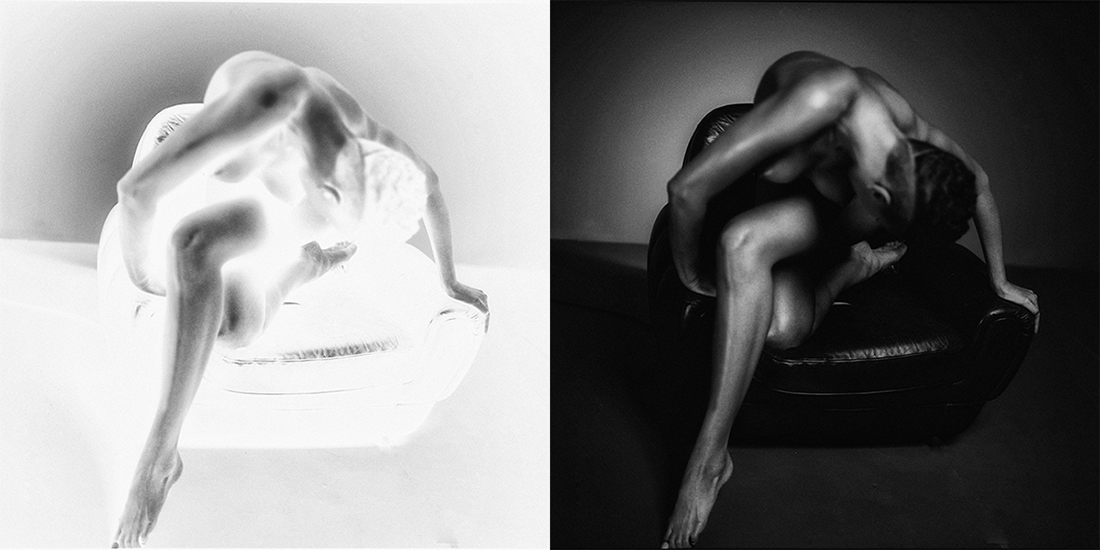
We also messed around with Rollei Ortho, orthochromatic film rated at ISO 25. I fell for what it did to her skin, it came back with this silvery polish, as if the light had been buffed into the print.

The negative and print from that stretch of the session have already been shown together. They belong here too, another return from the same experiment, Kat, the light, and the pleasure of seeing what the film decided to give us.

Over the span of these sessions, I realised how easily she could adjust to whatever space we were given. The scale swung wildly from one shoot to the next, but her attention to the pose never wavered.

Out among the rocks, a small gesture could stand up inside a huge landscape. In the studio, she could find a whole photograph within the strict edges of a chair.

And later, even the chair had taken enough of the spotlight.

This was the tail end of that shoot. Looking at it now, I can almost hear the picture speaking, plain as day:

“Alright, chair, that’s enough.”

There’s a kind of tenderness in returning to work like this. I remember the photographs I wanted, sure, but I also remember the person whose imagination made them possible. When you meet again over several sessions, it becomes a small shared history.

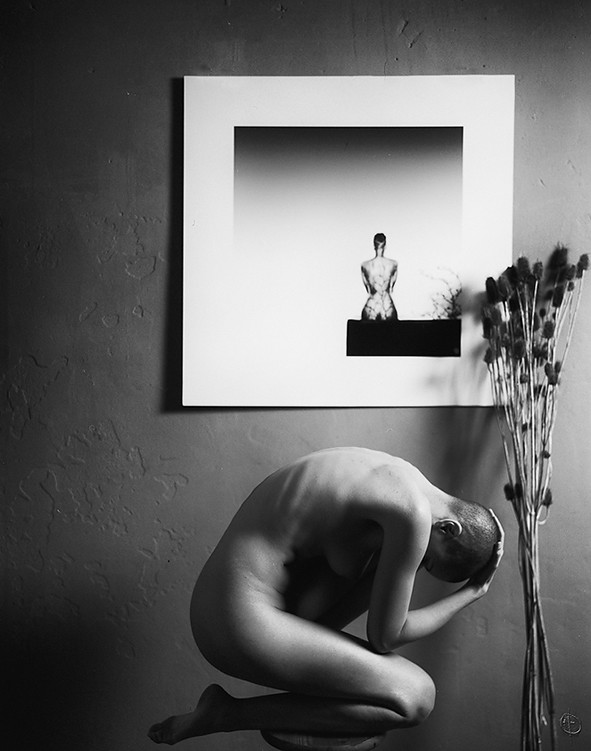
At our last shoot, I photographed Kat beneath a print of herself I’d made four years earlier.

In the print on the wall she’s upright, her back tall. Below it she’s folded forward, the spine catching the light. Two photographs, taken four years apart, crossing paths inside a single frame.

The image is called *Out of Reach*.

Eleven years went by between uploading it and finally giving it a home in this post. Coming back to it now pulls those sessions close again, the places, the shapes, and my quiet admiration for everything Kat brought into them.

Kat, thank you, for the inventiveness, the trust, and how much pleasure there was in working together. I could offer a beginning. You kept handing me something worth looking at.

*Photographs: Vernon Trent · Featured artist, model and collaborator: Kat*

I can see, but once I was blind…

At first, I saw the shapes.

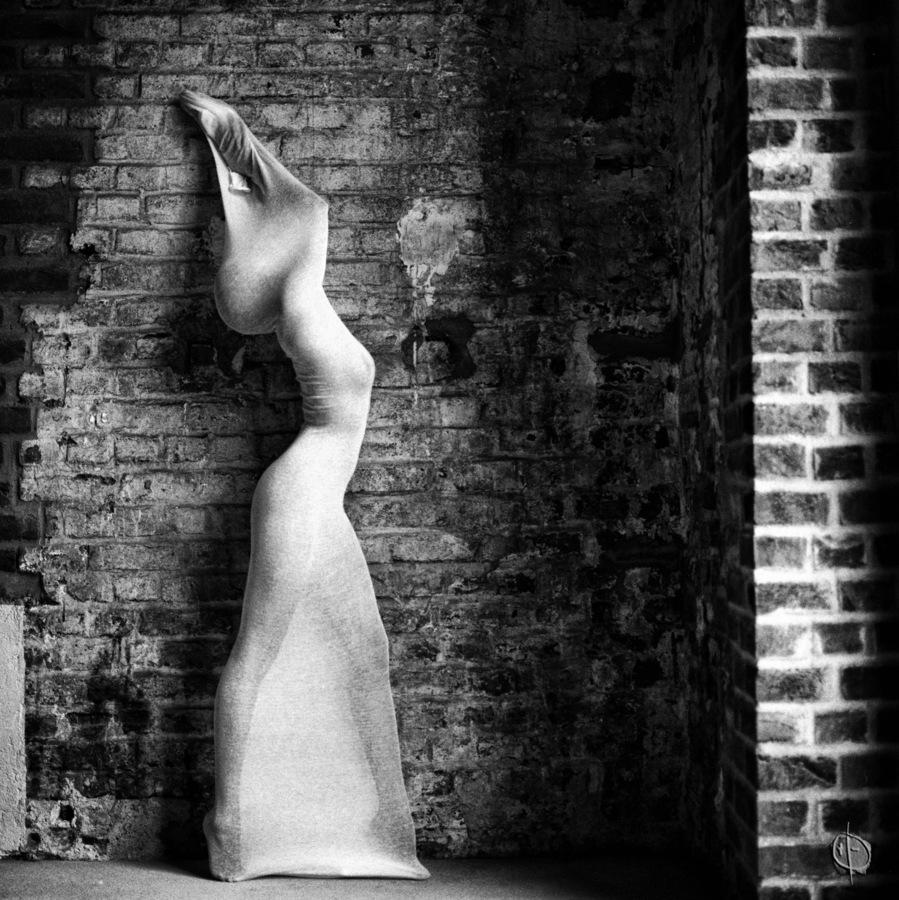
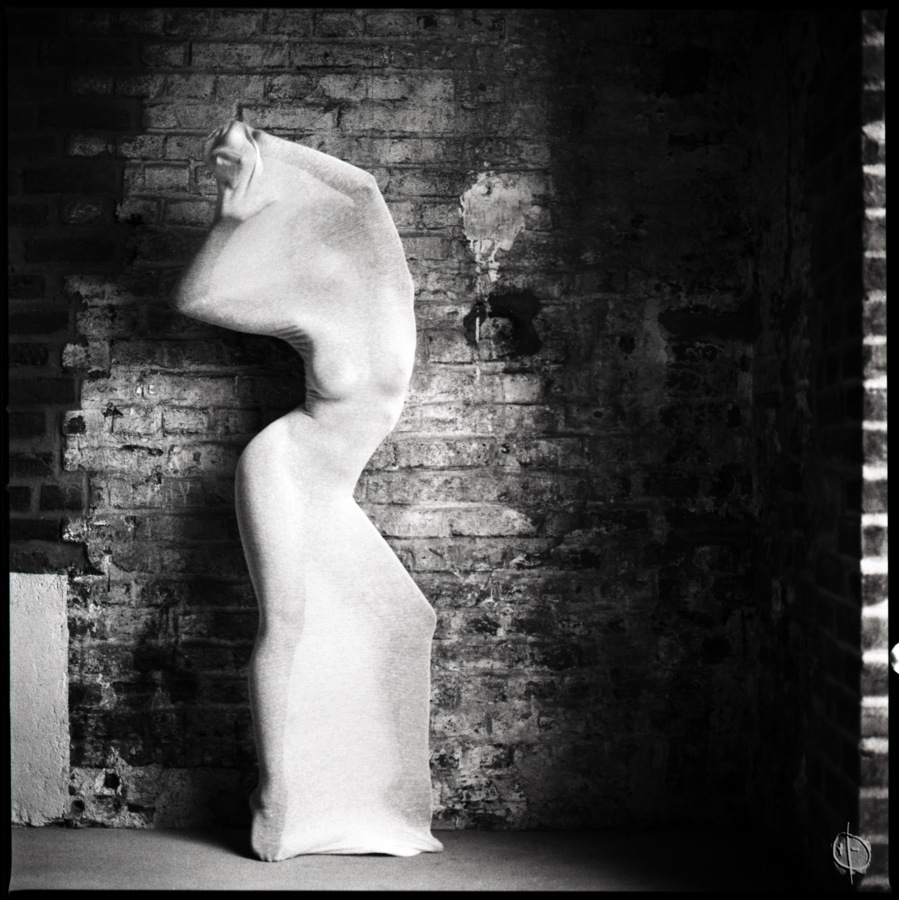
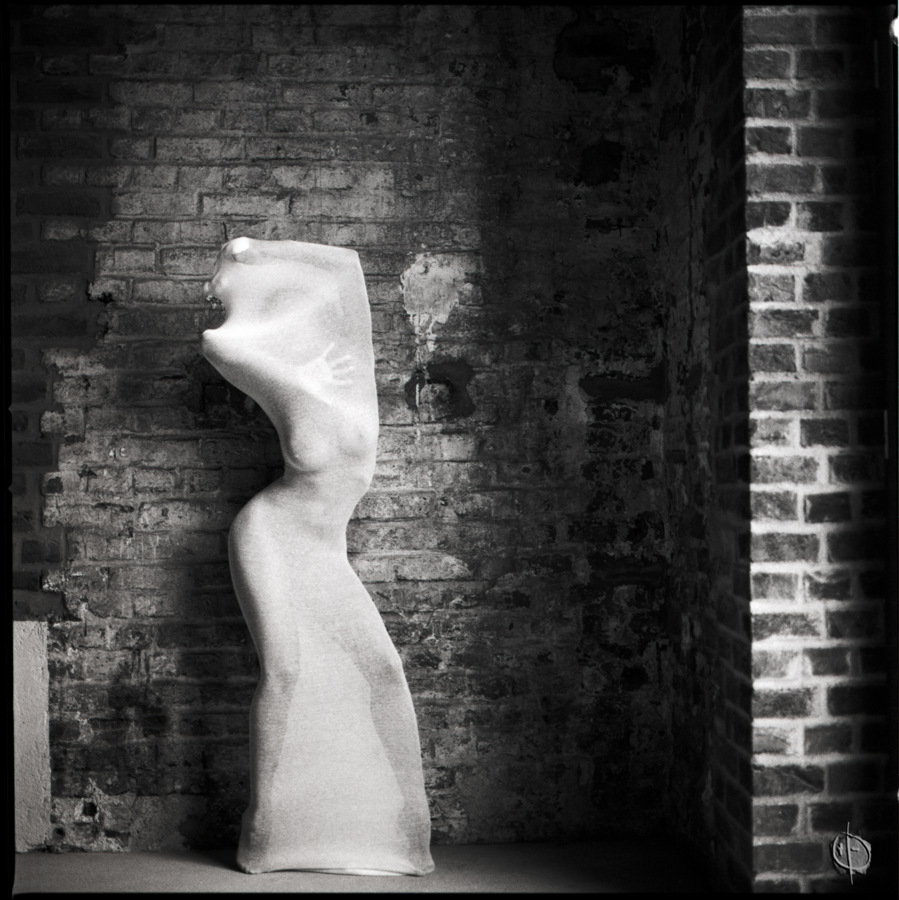
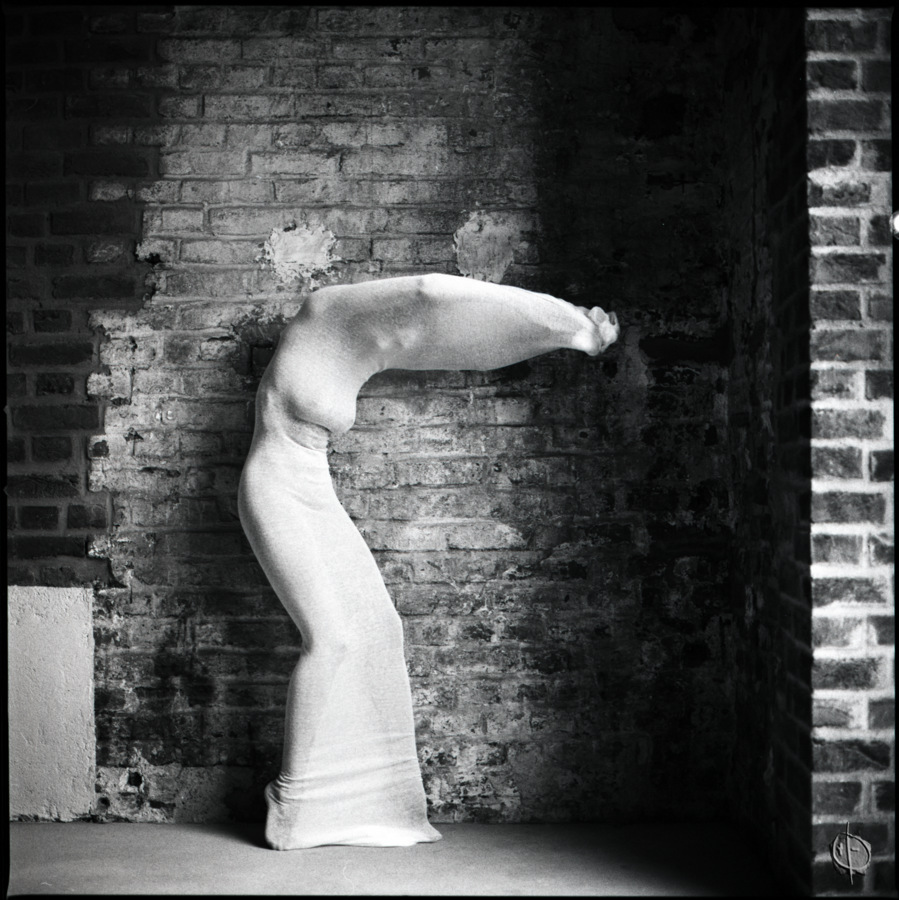
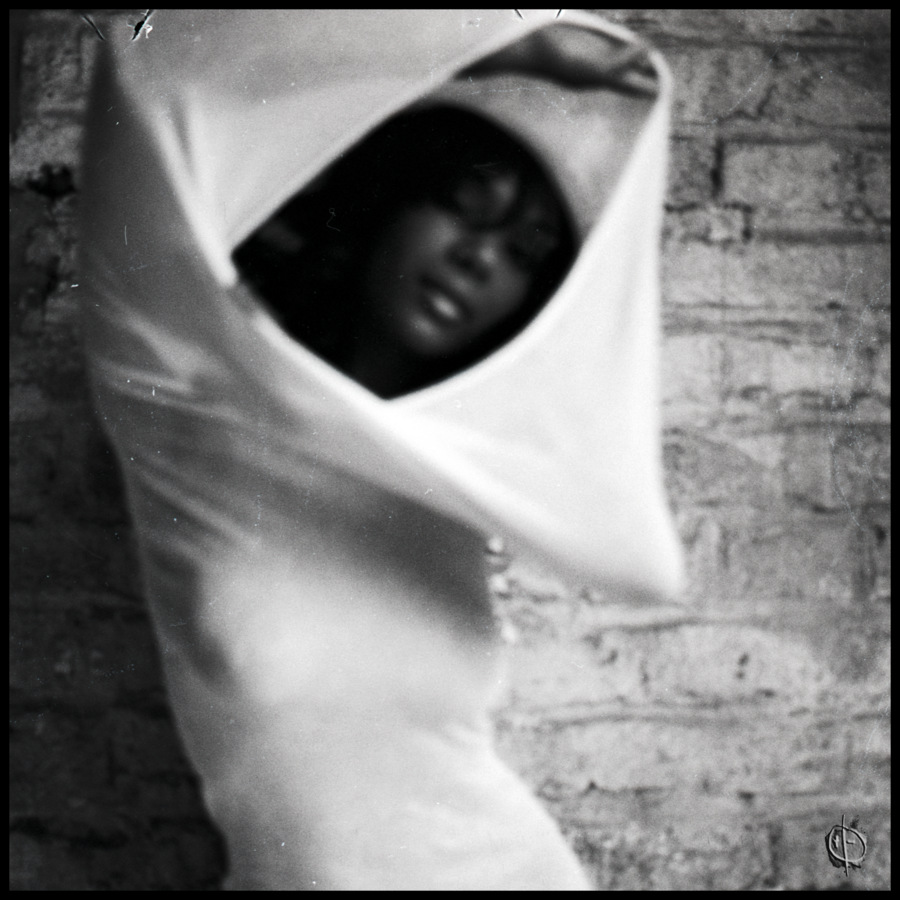
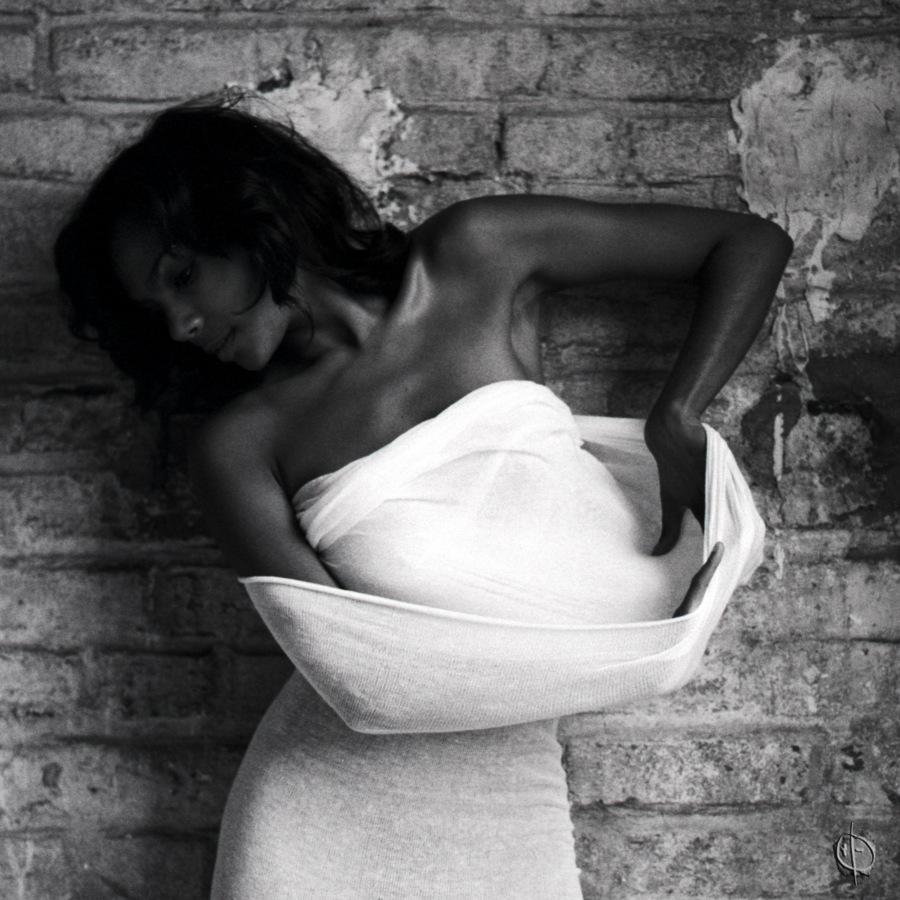
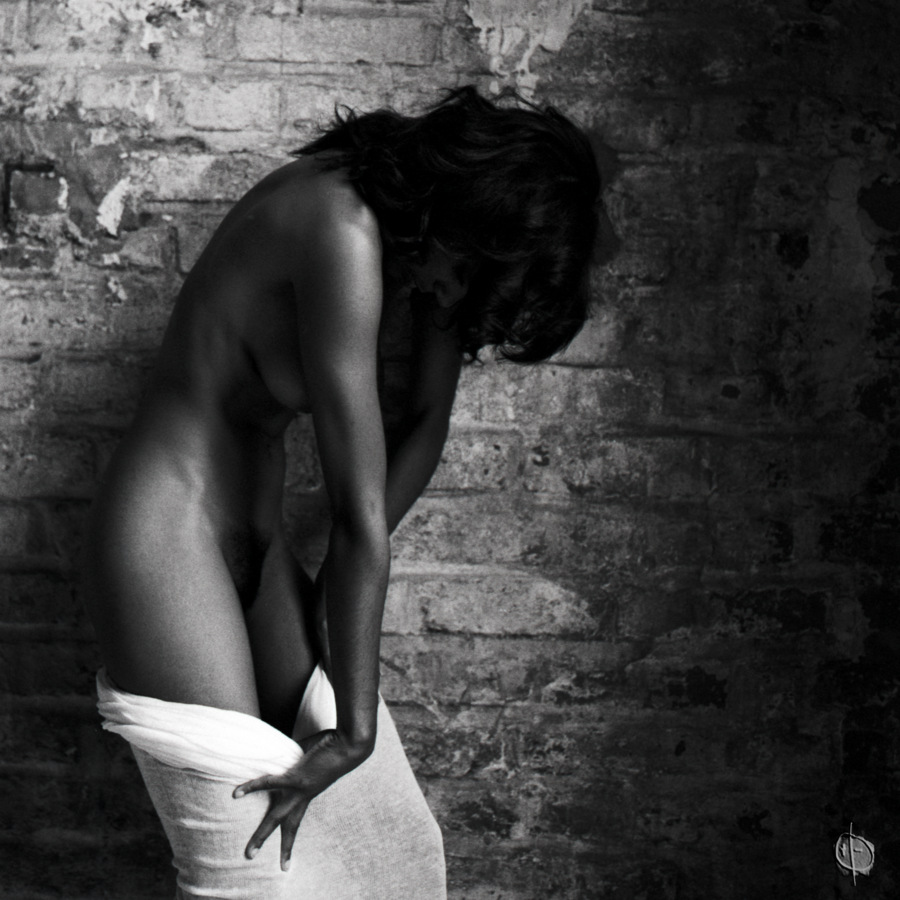
A pale figure against a rough brick wall. The narrow waist, the long curve of a body, an arm stretching the material into an unexpected angle.

Each movement offered another outline. Some looked almost like statues, held briefly in the light before changing again.

It began like many of my shoots. I gave St. Merrique something to play with, then watched what she made of it.

This time, it was Stülpa, a tubular bandage. It pressed close to her body, stretching as she moved. A raised arm pulled it into an angle; a turn changed the curve.

She kept finding possibilities, and I observed, freezing a moment whenever something caught my eye.

There was pleasure in that exchange. St. Merrique improvised, and I responded through the camera. I could choose when to release the shutter, but the next shape came from her.

At the time, I was absorbed in watching it happen.

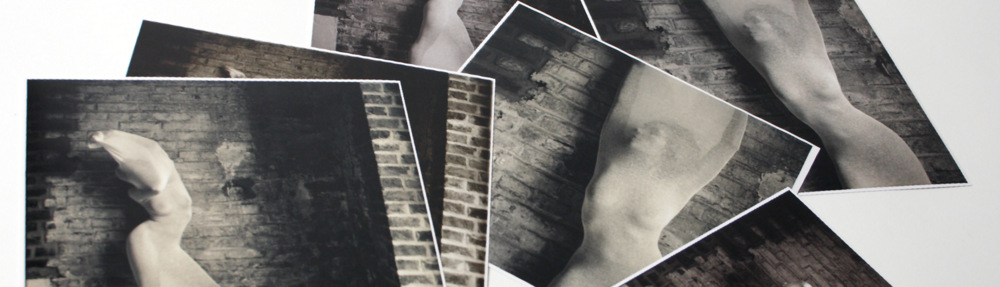
Later, looking at the film and then the prints, I began to read those same gestures differently.


I was responding to those forms… I began to read the same gestures differently.

The beautiful outline was still there. But now an arm reaching upwards seemed to be searching for a way out. The material across her face began to feel confining.

A hand was visible beneath the knit. Its fingers were a small detail within the whole photograph, yet once I noticed them, they held my attention. I began to look more closely at the person inside the shape.

Was she stretching into a pose, or trying to escape?
I knew what had happened in front of the camera. Yet the photograph allowed that question to remain.

The bandage began to look like a prison fitted so closely to the body that it accompanied every effort to move. It yielded, but stayed with her. A curve I had admired for its elegance could suddenly suggest strain.

I thought of a snake before shedding its skin: that moment when the covering still holds, although the body within is ready to leave it behind.

That thought came afterwards. I hadn’t gone into the session with a story about escape. It emerged from spending time with photographs I thought I already knew.

Then there was her face, appearing through an opening.
Seeing it changed how I looked back at the enclosed figures. The person was easier to recognise here, but she had been present throughout—in the pressure of a hand, the angle of a shoulder, the balance needed to hold a position.

How much did I need to see before I could recognise what was already there?

In other photographs, she takes hold of the covering itself. Her hands draw it away from her body, gathering it into folds. These gestures gave the idea of shedding something a physical presence.

Still, I couldn’t turn the whole series into a straightforward journey from confinement to freedom. Some photographs felt assured; others seemed vulnerable. Even an exposed face did not explain everything.

There was room for more than one reading, and for my own reading to change.

The photographs had not changed. My attention had.

That is where the title, I can see, but once I was blind, found its meaning for me. I had been looking carefully enough to make the pictures, yet there were things in them I still needed time to recognise.

It made me think about the little things we pass every day: a gesture, a hesitation, an effort whose importance we cannot judge from the outside.

We recognise an outline and move on. Sometimes, staying a little longer changes what we understand.
Something almost invisible to us might mean the world to the person living it.

I still enjoy the shapes that first caught my eye.

But now, when I look at these photographs, I stay a little longer with the person inside them…

Photographs: Vernon Trent · Model and collaborator: St. Merrique


The ‌space ‌between ‌things – I

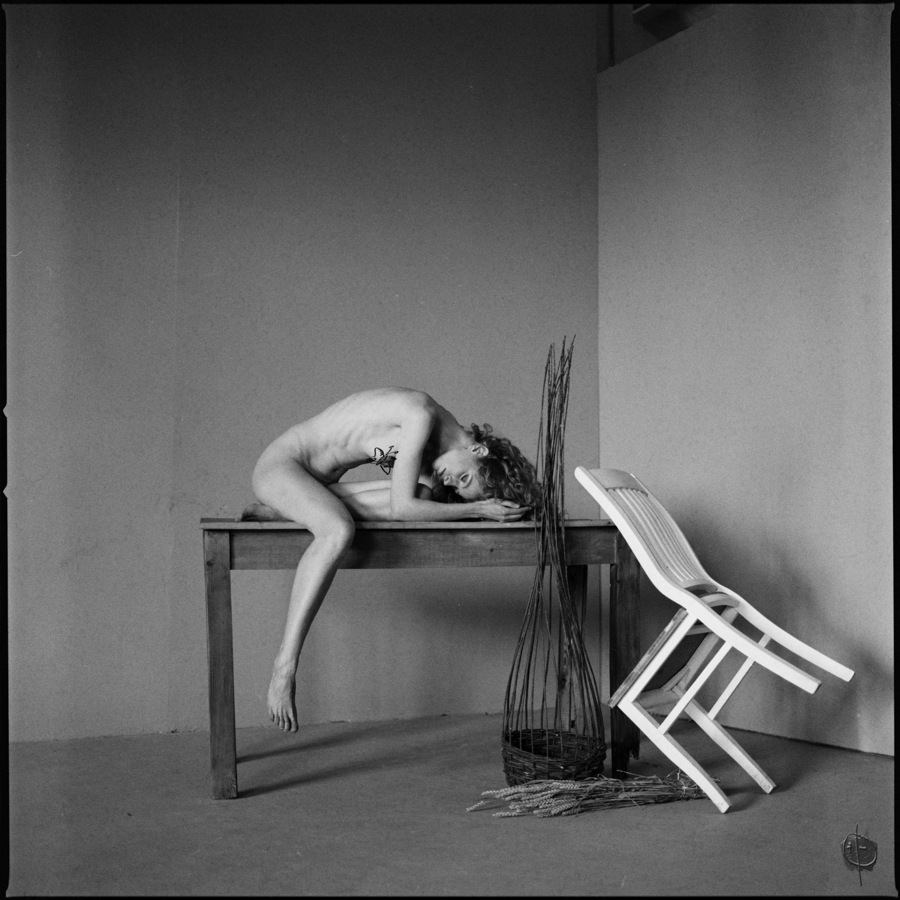
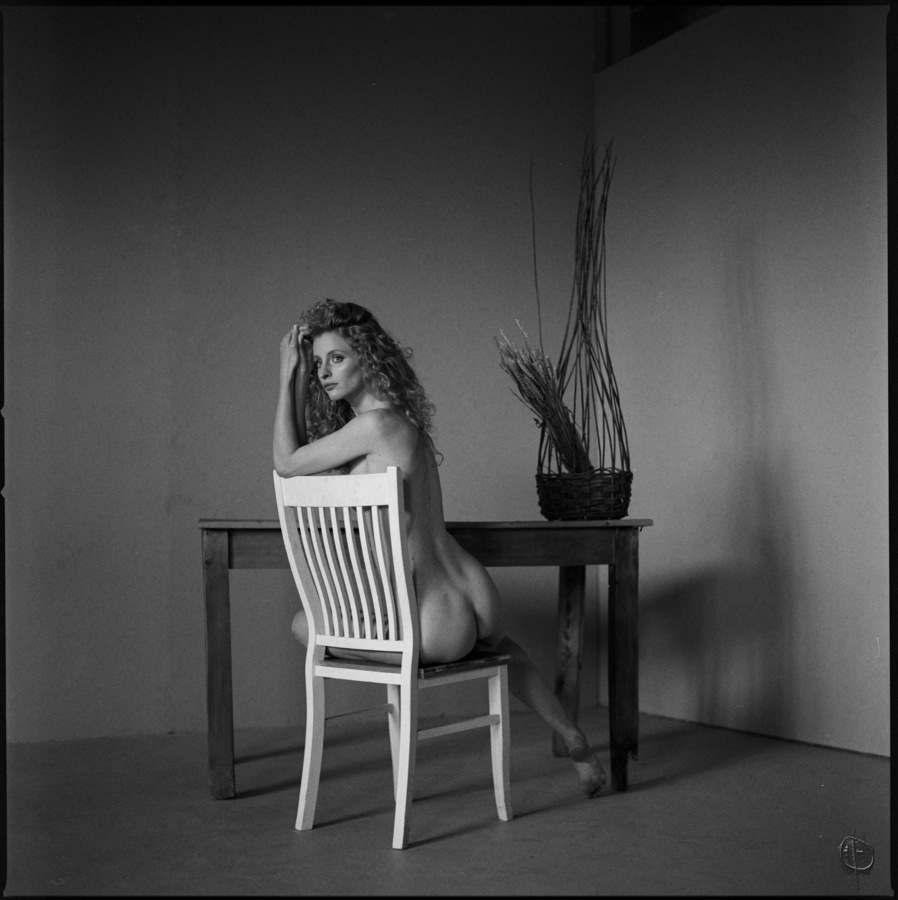
I nudged the chair closer to the table, then backed up to see it.

Too close.

Nothing about it was “wrong.” A person could sit there without thinking, pull the chair in, lay their forearms on the tabletop. But through the lens, it all pressed together. The chair fell into line with the table too neatly, and the bit I needed, the breathing room for the picture, vanished.

So I slid it back.

From across the room she watched, calm and familiar with the routine. We’d done this before. She knew what these first minutes look like, a plain object shifting a few centimetres at a time while I try to name a feeling I can’t quite put into words.

Fredau brought her own understanding of shape and gesture to the work. I could arrange the furniture and explain the feeling I was looking for; she found ways to inhabit it that I could respond to through the camera. Sometimes I guided her. Sometimes a movement of hers gave me the next photograph.

The series grew between us. The solitude we made visible depended on the trust we already shared.

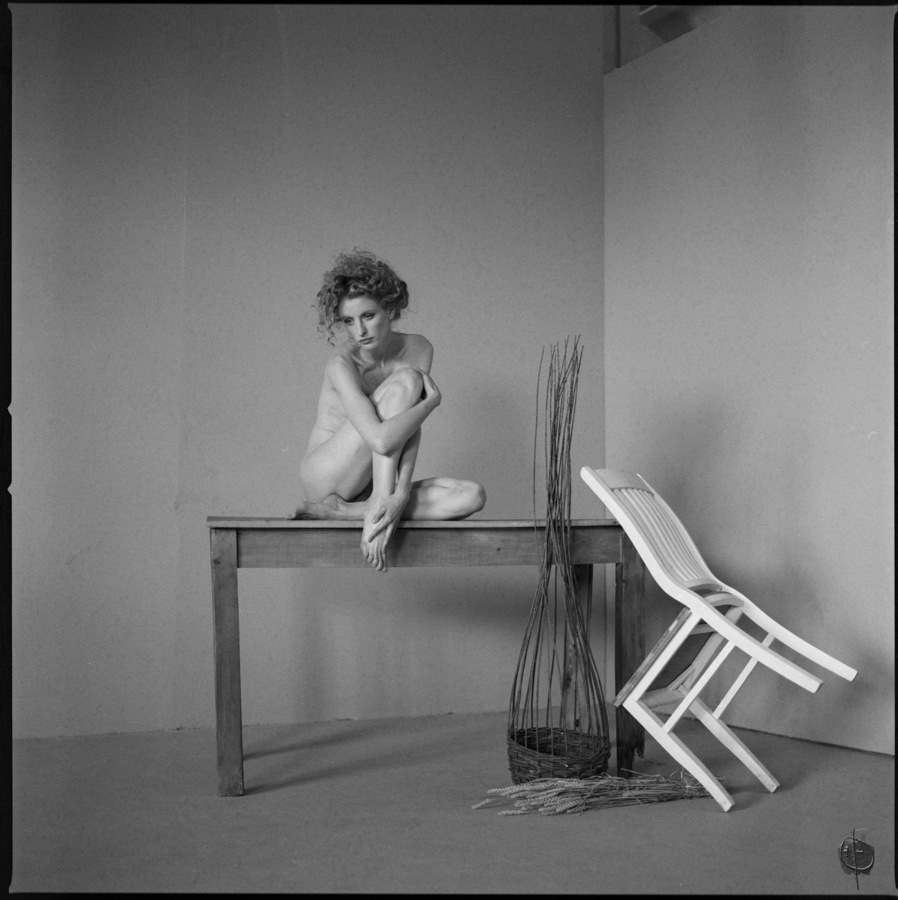
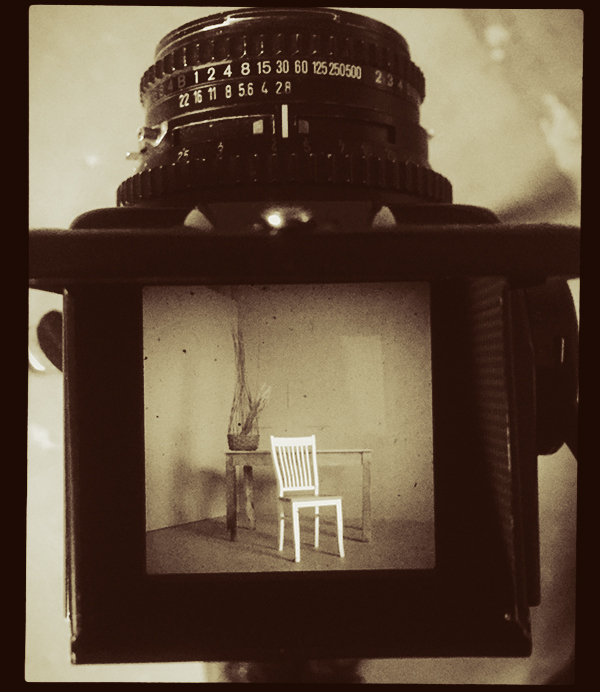
The table read as almost black. The chair, stark white. And beside them the tall basket, its stems thin and a little unruly.

I set the basket down, then gave it a small turn. A couple of loose stalks dropped and lay on the floor, and I didn’t bother to rescue them.

There’s a narrow point where things feel separate without looking abandoned. I kept walking up to it and overshooting it, then circling back again. Too near and the outlines started knotting together. Too far and the whole room looked accidental, like I hadn’t cared. What I wanted was simple to say and hard to get right, each object with enough space around it to be felt.

Maybe I was asking too much from a table and a chair.

When I finally looked up, she came over.

I tried to describe the shape I was after. She climbed onto the table, straightened for a second to find her balance, then folded forward.

Light skimmed her back. One leg slid over the edge, the foot hanging well above the floor.

I went to the camera.

All those straight lines I’d spent so long placing, and then her curve cutting through them. She took up very little of the room. Above her the wall carried on, and on, for what felt like an unfair distance.

I kept it.

I’ve never stopped wondering how an empty part of a photograph can end up feeling heavy. If you looked at the wall by itself, there was almost nothing there. Put her under it and suddenly the space had weight, as if it settled across her shoulders, ran along the tabletop, reached toward the chair without ever letting the two fully meet.

*click*


Afterwards she lifted her head and pushed hair off her face. I glanced down at the camera, letting a small pause land between us.

I knew I’d brought solitude into the room. That part was clear. What surprised me was how quickly I could recognise it once we started.

Working closely with someone while making pictures about distance is strange. We trusted each other. We had that easy familiarity that doesn’t need filling with talk. I could tell her where I wanted to begin, then step back and see what she offered.

Sometimes she stayed still while I looked. Other times she shifted before I’d said a word, and I caught myself following her instinct instead of my own plan.

When she pulled her knee toward her chest and looked straight into the camera, I thought that direct gaze would tip the mood into something else.

It didn’t.

Her eyes reached me. Everything around her stayed put.

I recognised that feeling from my own life, from rooms where I’ve sat answering, listening, participating, while a small private distance persisted that no one else seemed to notice. I’ve never had a clean way to describe it. Here it was, suddenly visible, something I could look at without trying to explain.

She held the position.


Bit by bit I felt we were moving toward the same atmosphere. I couldn’t know if it meant the same thing to her, but she seemed to understand what I was doing with the space around her, and how little it took, a slight shift of a wrist or a shoulder, for that space to feel heavier or lighter.

The solitude in the pictures didn’t come from being apart. It grew out of that closeness. We could reach it together.

We moved the chair.

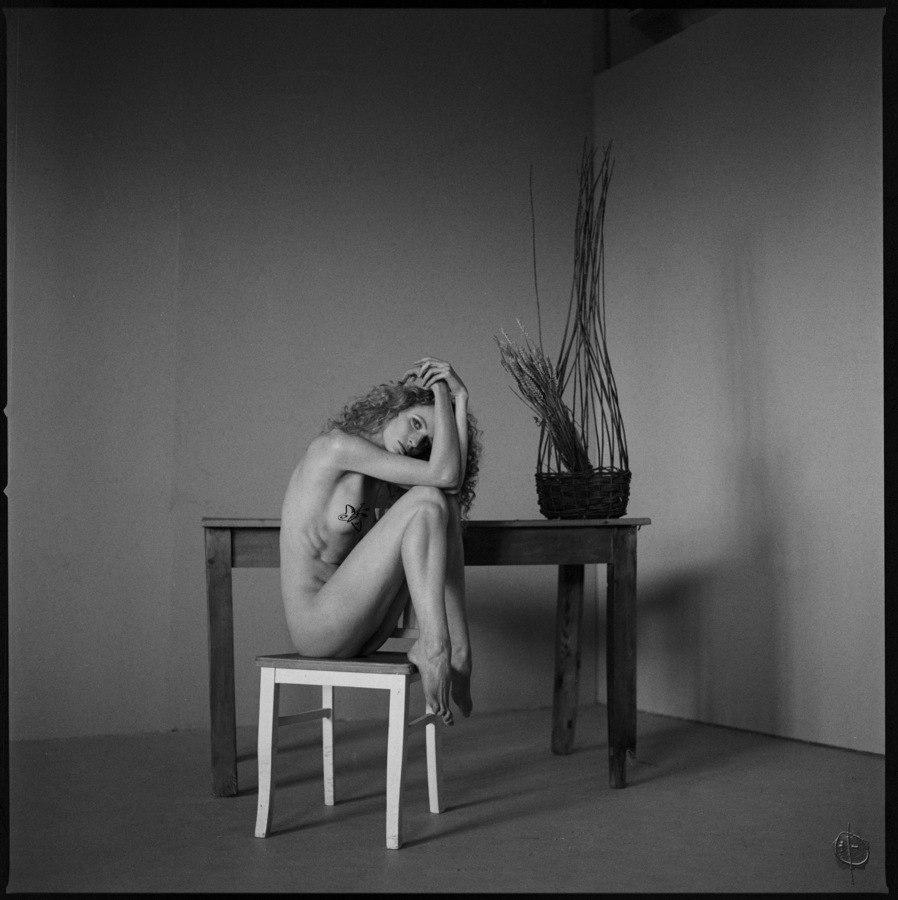
With her sitting in it, the whole setup changed. The white legs made a small boundary under her, a kind of tidy enclosure. She folded inward, arms up over her head, knees drawn close. Now the basket stood behind her on the table, its stems stretching into the wall’s emptiness.

I watched the gaps.

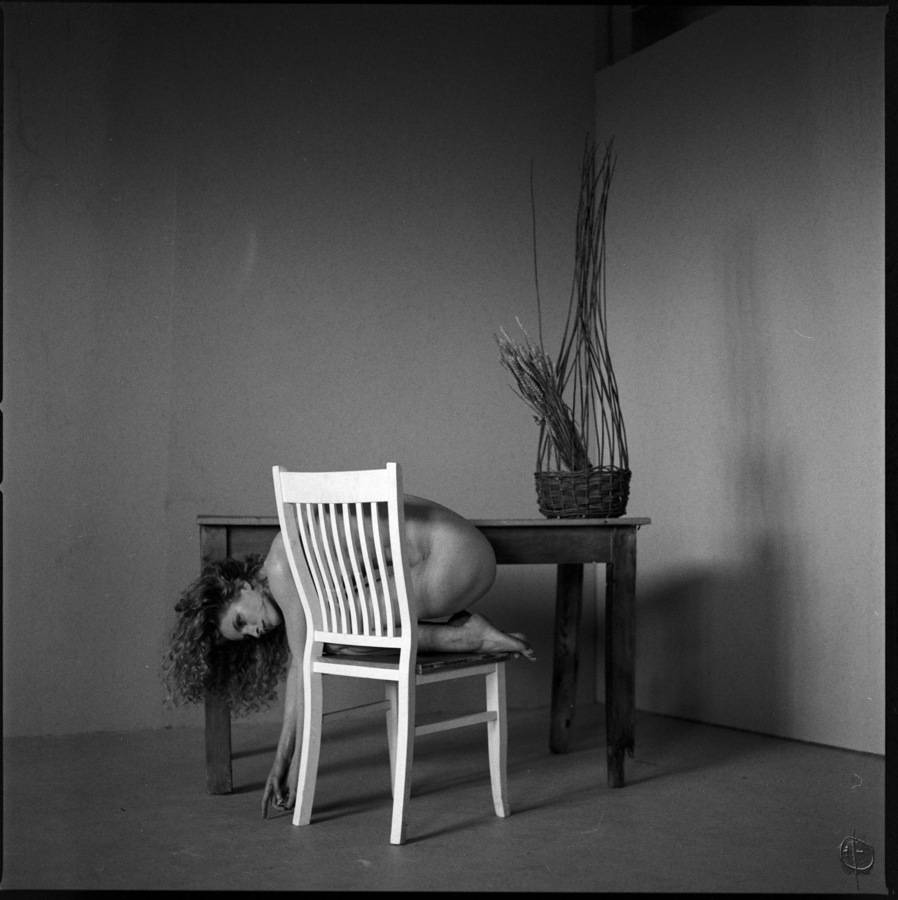
Between her elbow and her face. Between chair and table. Under a foot, beside a hand. Each little opening changed how her body held itself together, like the picture was built from what was missing as much as what was there.


She turned away, then looked back over the chair.

I could see her face, the line of her spine, the strip of light running along her arm. The furniture and the shadows stayed in their own places, separate and steady. Her gaze connected us across the room, yet the distance inside the frame didn’t go anywhere.

I wanted whoever eventually looked at the finished photograph to feel that, too. To linger a moment. Maybe to recognise something of their own in the space we’d left.


Later she folded behind the chair’s back. Her hair spilled toward the floor. One arm hung down, fingers almost brushing it.

I waited.

The chair was bright against her, almost too bright. Its narrow wooden bars broke up her shape, and I had to follow what I could see and quietly imagine the rest.

Nothing needed adjusting.

For once I didn’t search for another angle, or wonder if the basket should rotate just a touch. The room had finally gone quiet in the way I’d been trying to make it quiet all along.

*click*


When she stood, I thanked her. She stretched, and the chair returned to being just a chair, empty again.

I looked through the camera one more time.


Everything sat close enough to reach out and touch.

And still, the distance remained.

Fredau and me, between photographs


Photographs: Vernon Trent
Model and Muse Collaborator: Fredau

The space between things — II: A little closer

After the table and the chair, I edged in.

Some trace of the last setup was still on her, in the way she carried her body. Or maybe it was on me, in the way I looked back at her. We’d spent time clearing a place for solitude, and I couldn’t just drop that feeling because the furniture part was done.

The room kept going behind her. There was more in it now than I wanted to name. When I moved closer, it all blurred into fields of light and shade, outlines loosening, detail slipping away.

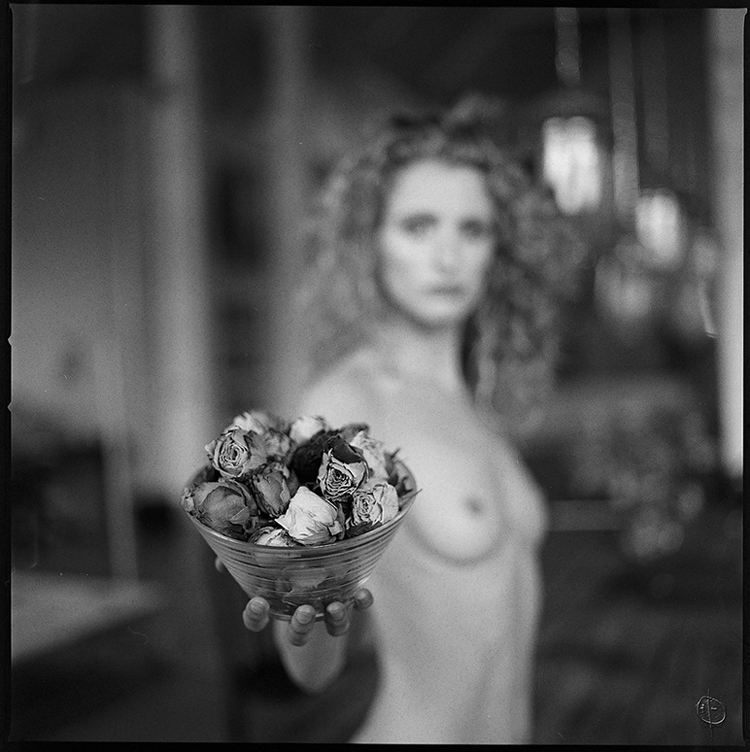
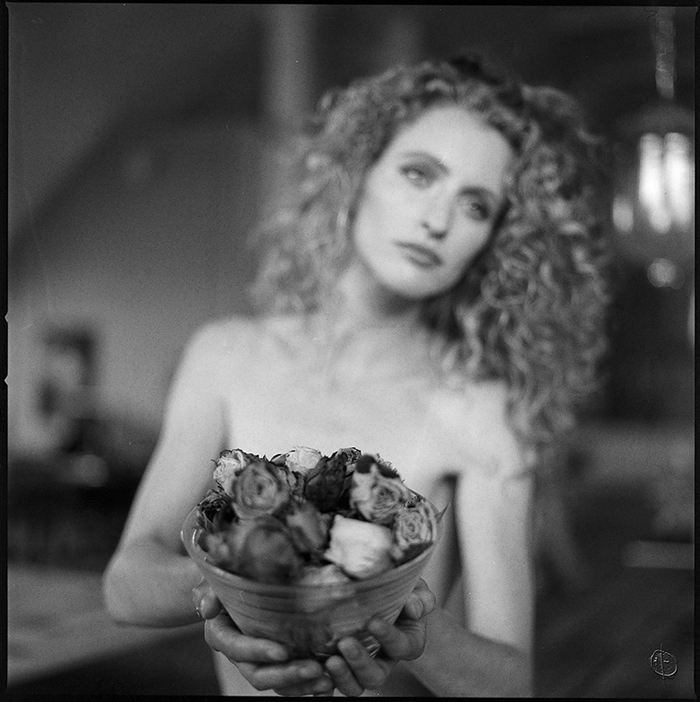
In her hands was a bowl of dried roses.

I stared at the curled petals, at the little pockets of darkness between them. Flowers that had held on to their form while letting something else go. Her fingers circled the bowl, steadying it from underneath, and she offered it towards me.

So I stayed with the roses.

Her face softened behind them. I could still read the expression, even if I couldn’t study it. That felt right. The flowers were near enough to inspect, while the person holding them stayed a touch out of reach.

*click*


She drew the bowl back in, close to her body, clasped with both hands. Over its rim we met each other’s eyes.

We’d worked together often enough that silence didn’t feel like a gap. I didn’t have to rush her into giving me something for the camera. She could wait, shift, let an expression pass through without pinning it down for my benefit.

That ease started to matter more as the distance between us shrank.

When the whole room was in the frame, I could track the spaces between objects. Up close, the smallest tilt of her head remade nearly everything. A shoulder angled forward. Her hair fell in a new way. Light caught one eye and left a thin shadow under the other.

I watched for those subtle turns, trying to feel the moment when a gesture stopped moving and became something I wanted to keep.

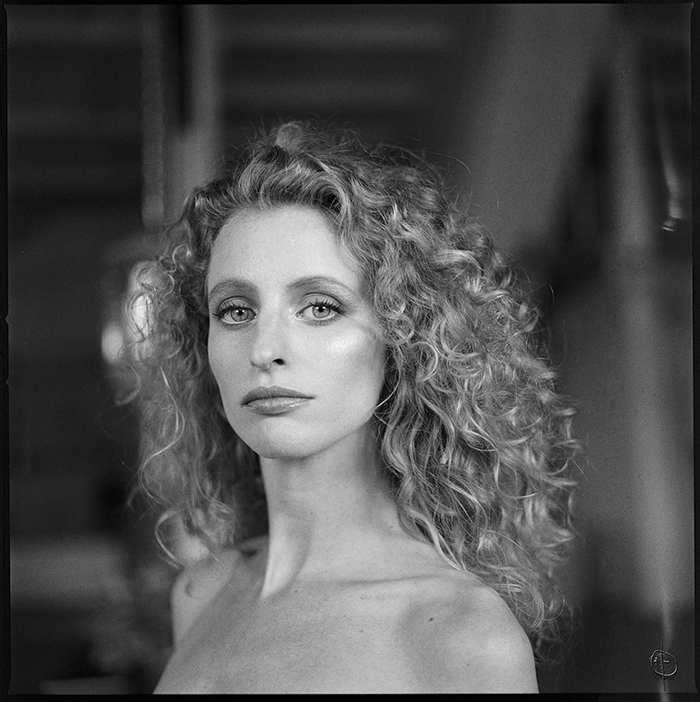
When a face is close, there’s always that pull to believe it will explain the person. I’ve never known what to do with that hope. I could see light on her skin, the set of her mouth, the steadiness of her gaze meeting mine. Whatever else lived behind that would stay with her.

The bowl slipped out of the frame.

With less to distract me, I looked harder. The line of her collarbone led cleanly into the shoulder. Curls held onto tiny flecks of light. She turned, and the face I knew rearranged itself into new curves and shadows.

For a beat, she looked straight into the lens.

The image felt quiet. Our familiarity was in it, unmistakable, and still there was a distance I couldn’t measure. Bringing the camera closer didn’t dissolve it.

I thought of the empty wall above the table.

Here, there was barely any empty wall left, and yet its weight seemed to hover around her anyway. It had slipped into smaller places, under her chin, between hair and cheek, along the shoulder turned away from me.

She moved again.

A few curls fell across her face. I let them stay. One eye disappeared halfway, and I had to read the shape of her head without seeing all of it.

I liked being made to do that.

For much of the shoot I’d been deciding where everything should sit. Now I wanted to give a little space to what happens between decisions, hair dropping, a hand finding an arm, that brief pause after she turns.

She folded one arm across herself.

I watched the hand resting against her skin. Anyone looking at the photograph might call it comfort, or guardedness, or simply somewhere to place a hand. I didn’t need to choose a meaning for them.

I just wanted it to feel true.

As we kept going, I started to feel how carefully fragility has to be allowed in. Too much direction and it stiffens into a pose. Too much hunting and I miss what’s already there.

I trusted her to find her place in the picture. She trusted me to notice it.

Later, her arms lifted and her head settled down into them.

Through the camera I followed the shoulder into the upper arm, then the forearm cutting across the frame. Her face rested inside that shape, eyes closed. Behind her, the room showed up only in bits and pieces.

I stayed with it for a moment.

Earlier she’d folded over the table, chair nearby, a big bare wall above. Now the frame held just a portion of that same person, drawing herself into a different kind of quiet enclosure.

Something familiar passed through me, even though the photograph wasn’t the same.

Maybe that was what remained with us all afternoon. We shifted the furniture, set the flowers aside, moved closer. Each change gave the feeling a new outline.

*click*


Then she let her arms drop and looked up. We were still there, still working together, with the plain room around us.

I stepped back, so she could have a little more space.


Medienhafen, ‌framing ‌it from memory

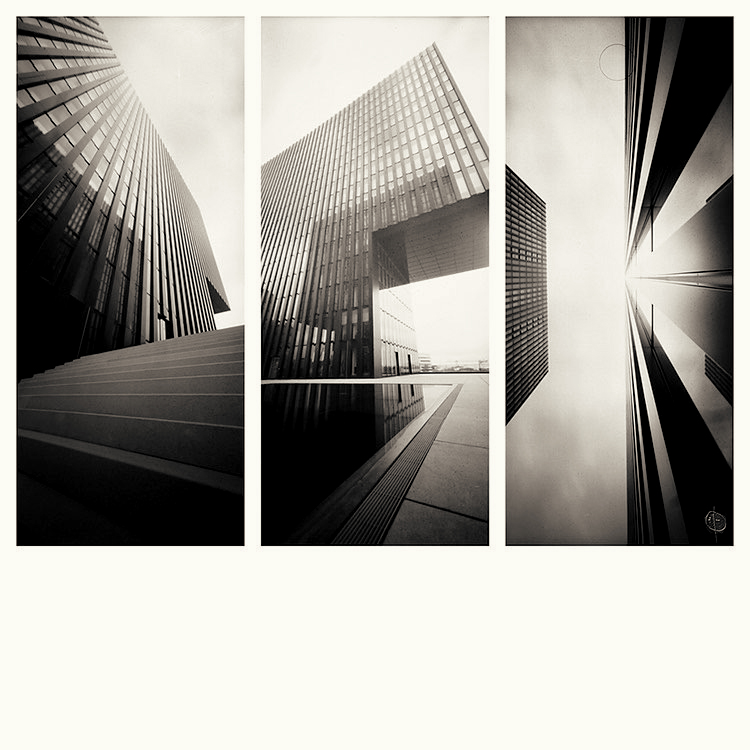
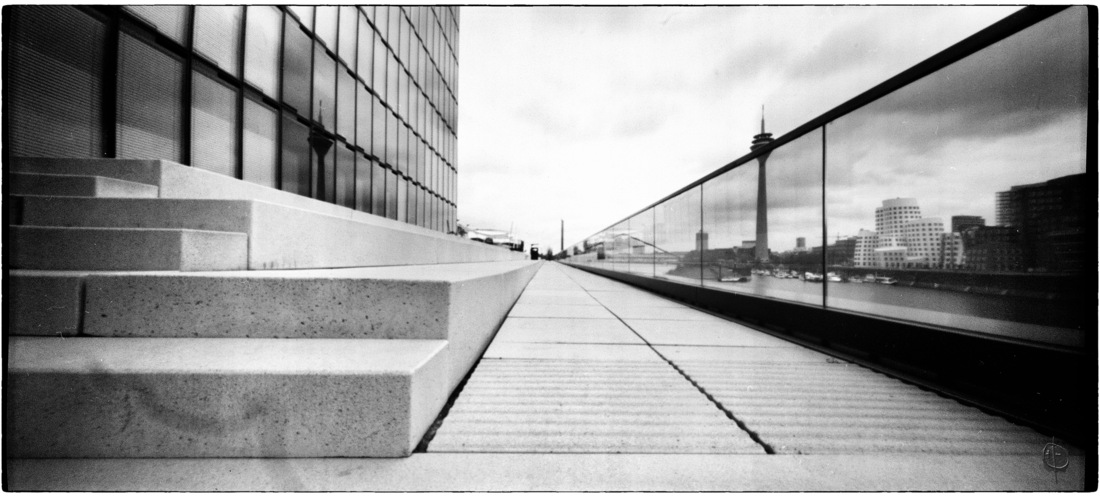
Worldwide Pinhole Photography Day landed on Düsseldorf, so we took our cameras and wandered through the Medienhafen. The old harbour kept handing us scenes: sharp façades, odd bits jutting out, those tight gaps where buildings almost touch, and lines that kept rearranging themselves the moment you tilted your head up.

I went with the Holga 120 WPC because of the format. I wanted to see how that wide view would swallow the architecture, and what sort of version of it would come back to me once the film was developed.

Of course, there’s no viewfinder. You don’t “check,” you guess.

Three lines and a spirit level

The Holga does give you a hint, just not much. Up top there are three little marks, one aimed straight at the pinhole, two flaring out left and right. They more or less tell you what you’re getting horizontally. Up and down, though, you’re on your own.

Yes, there’s a spirit level. It can tell you if you’re straight, it can’t tell you where the building is going to end up inside the frame.

Some moments feel like moving through daylight with the confidence of someone in the dark. 🙂

Still, I’d already used this camera earlier that year in Domburg. Those negatives taught me, slowly, what the Holga “sees.” After looking at the prints, I started linking where I’d been standing to what showed up on the film, how far back was enough, what “too close” really meant.

I carried that lesson into the Medienhafen.

In a place like that, stepping back and forth to refine the framing isn’t always possible. You stand where you can stand, and from there you decide whether it fits. I thought it would, based on what the camera had shown me before.

When the film came back, it backed me up.

Fifteen seconds

Everything was on a tripod. Each frame was a fifteen-second exposure on Foma 200, shot under a solid overcast.

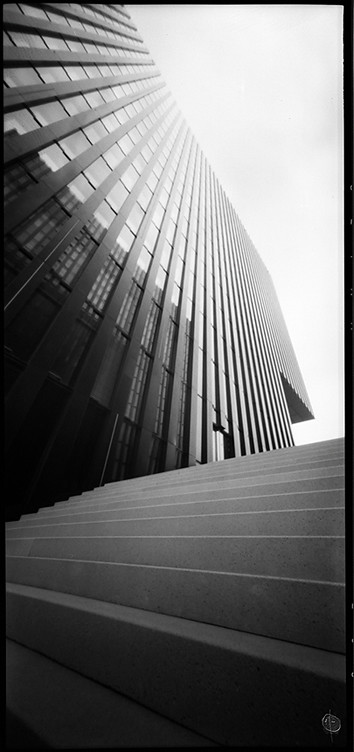
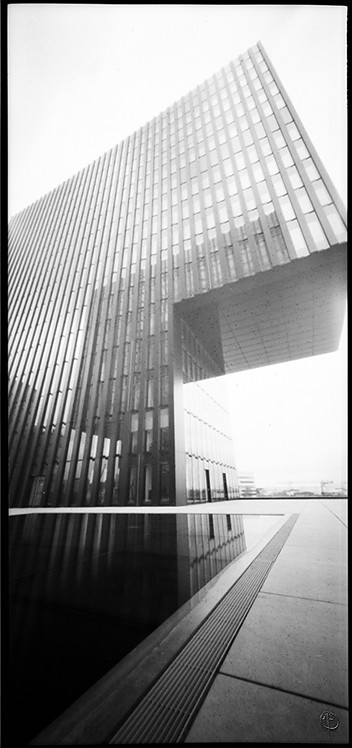
What I like in the results is the mix, clean architectural lines, but with the pinhole’s softer way of drawing. The steps and façades stay readable, yet the light gives the buildings a kind of weight that pulls me in beyond individual details.

Across the three views, the same place shifts shape. In one shot, the façade lifts up from the stairs as if it’s sweeping. In another, a section that sticks out creates a bright pocket of space underneath. Looking upward, the buildings pinch in, guiding your eye to a narrow slice of sky.

I didn’t want them to live separately. I wanted them together.


One sheet, three exposures

So I printed the triptych onto a single sheet of photographic paper.

First came a cardboard mask, cut by hand, then laid over the enlarger easel. That set the three windows and the thin gaps between them. With each negative, I shifted the easel carefully so the next exposure landed exactly where it was supposed to.

That placement had to stay steady the whole time. One small bump, a tiny accidental slide of the mask or the easel, and the alignment could be ruined after part of the sheet was already exposed.

Every panel got the same printing time.

When I print each image on its own, the tones match nicely. On the shared sheet, the middle photo keeps a brighter patch toward the centre-right. I was fine with it. The scale still holds, and the triptych still reads the way I wanted.

There were also plain practical limits. While swapping negatives and nudging the easel into position, the paper sat under the safelight. Safelight isn’t magic, it still runs out of “safe” if you leave paper under it too long, and fog starts creeping in.

And once the alignment felt right, I didn’t want to keep touching things. Every extra adjustment is another chance to move the one thing you absolutely need to stay put.

The mask was simple. Getting three exposures onto one sheet without drifting took attention.

Looking at the whole

What mattered most wasn’t any single frame, it was how the three sat together on the finished sheet.

Those narrow white breaks keep each view separate, but the repeated lines carry your eye across the set. The bigger margin at the bottom gives the arrangement a bit of breathing room. And that small tonal difference in the middle panel doesn’t interrupt the relationship for me.

Making it came down to two kinds of judgement. Out in the harbour, I trusted what earlier Holga photos had taught me about framing without a viewfinder. Back in the darkroom, I worked carefully enough to put the three prints on one sheet, then stepped back and decided whether it all held the feeling I was after.

It did.


*Making notes: Düsseldorf Medienhafen, photographed during a Worldwide Pinhole Photography Day walk. Holga 120 WPC, Foma 200, tripod, fifteen-second exposures. Triptych printed as three separate exposures onto one sheet of AGFA MCC photographic paper, using a handmade cardboard mask, same exposure time for each panel. Moersch SE4 Dev and Moersch Variotoner *

A ‌vase, ‌a ‌winter weekend

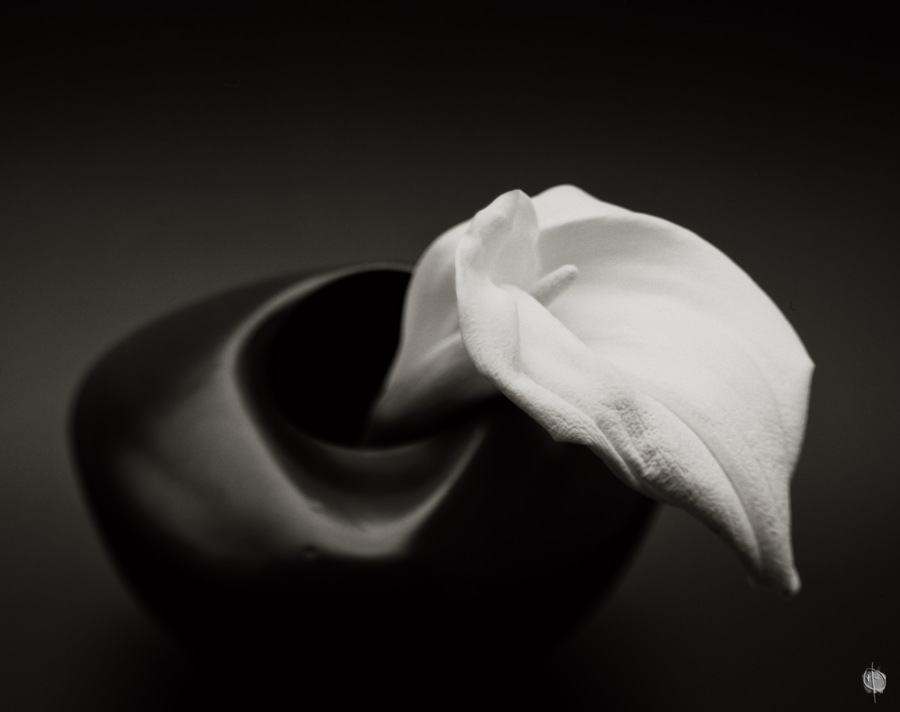
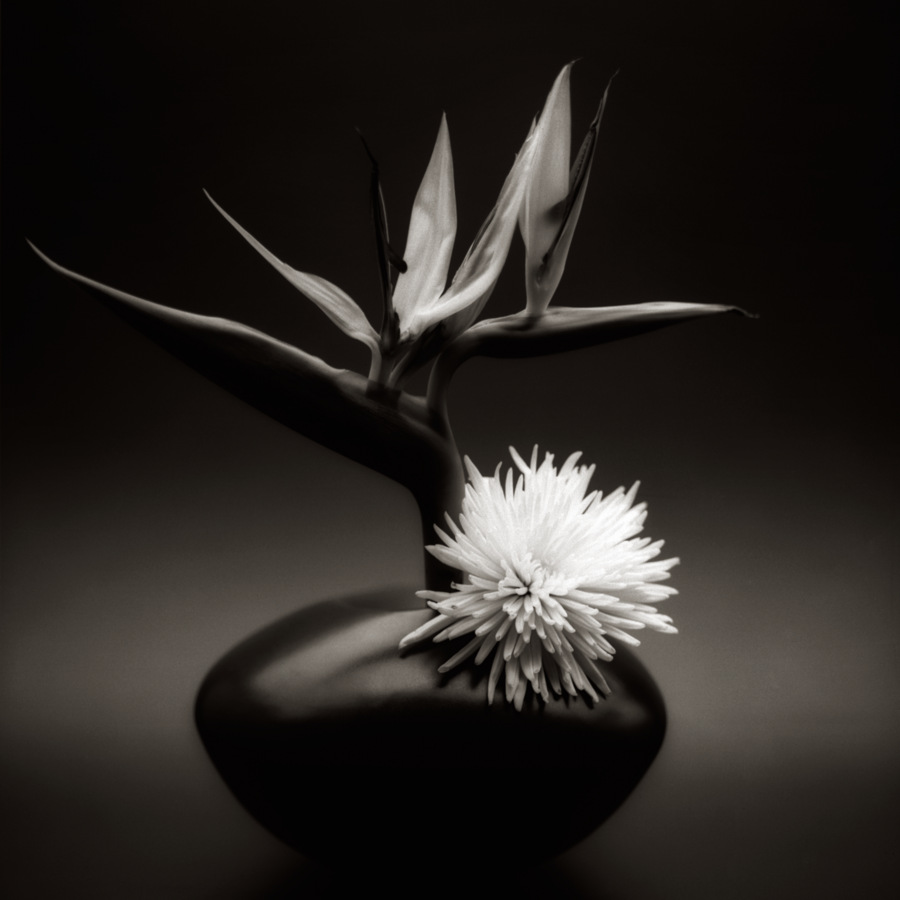
Winter 2010, a weekend, cold outside. I’d just been to the Robert Mapplethorpe retrospective in Düsseldorf, and I walked away with that familiar feeling of his work still humming in the back of my mind. The control he had, form, perspective, light, it always pushed me. This time it pushed a little harder.

I didn’t set out to make anything complicated. Black cardboard as a background. One softbox overhead. The Plaubel locked onto a heavy tripod. Vase on the table, flowers dropped in, and I began.

And then I didn’t really stop.

My way of working is to build things piece by piece. One object goes down first, then the next choice comes from what that first one suggests. Sometimes it’s the outline I’m chasing, sometimes it’s the shadow. Other times I’m not chasing anything at all, I’m just watching for the moment something clicks. A detail pulls at me, I answer it, and that answer sets up the next move.

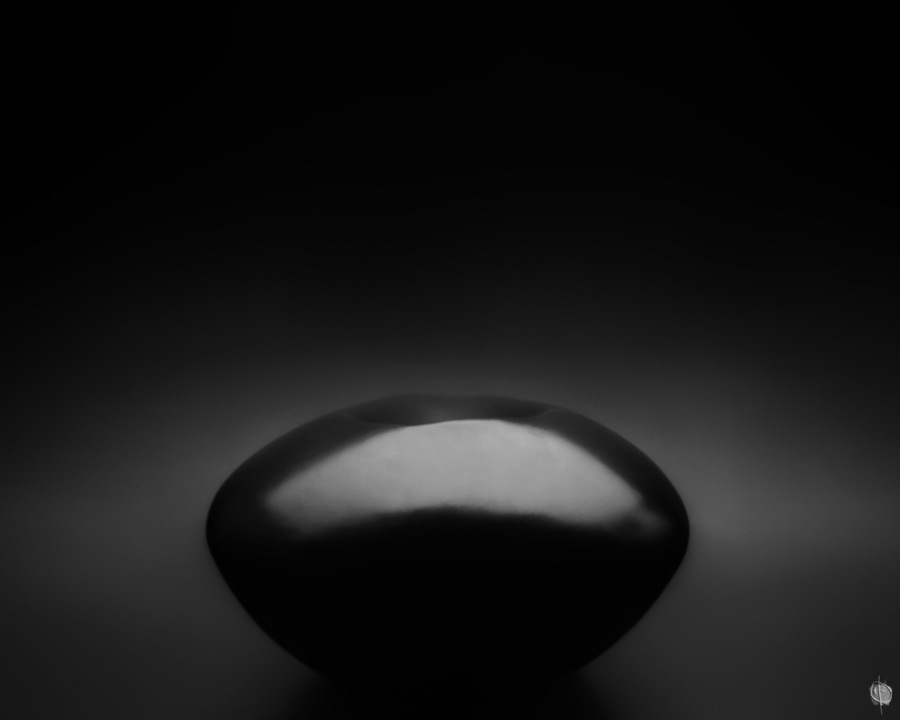
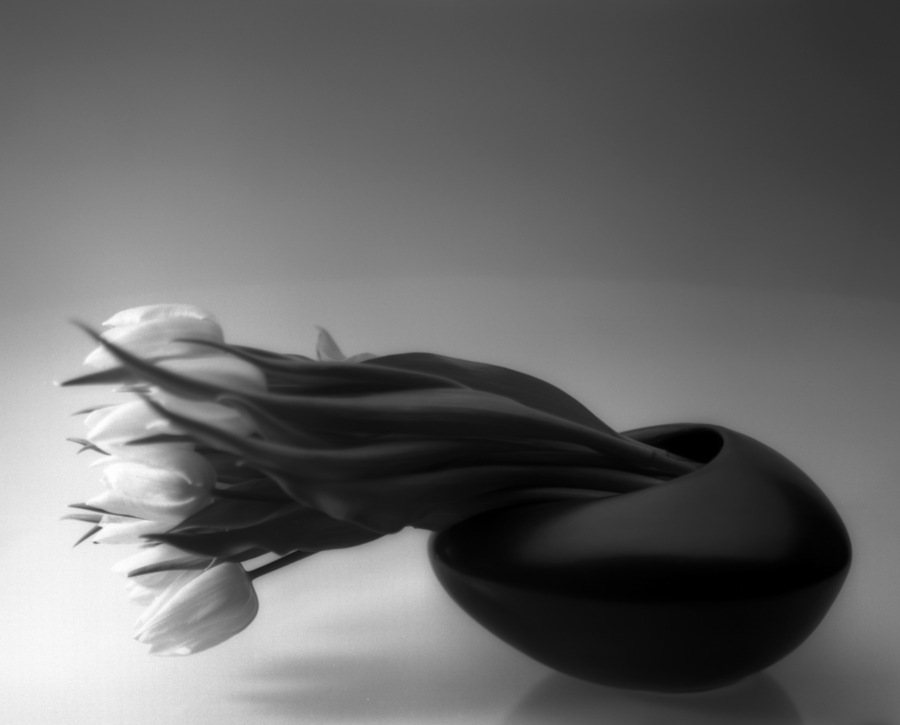
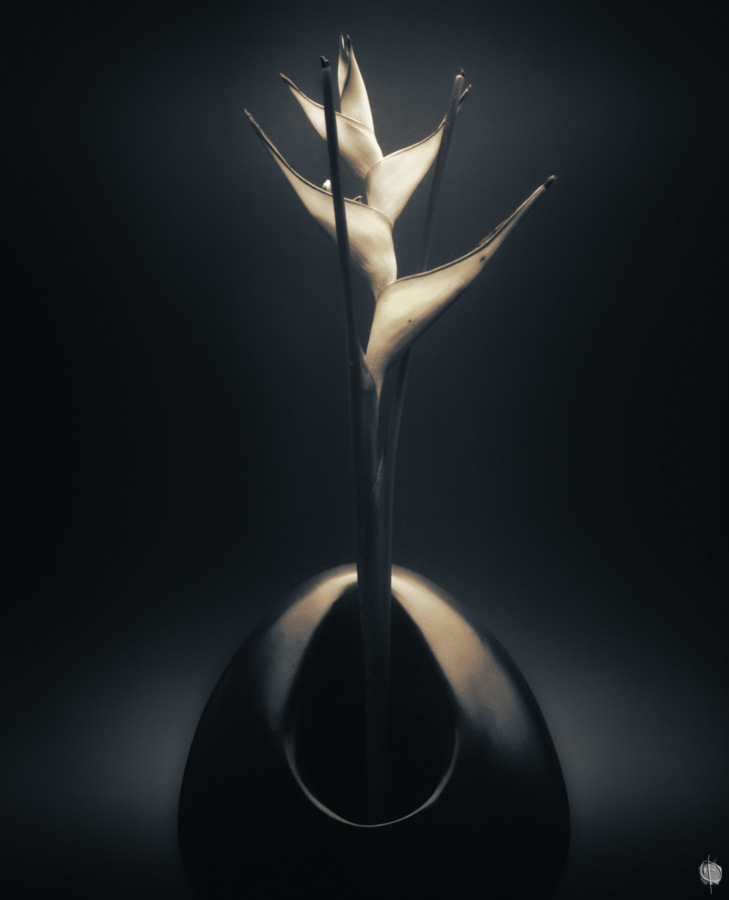
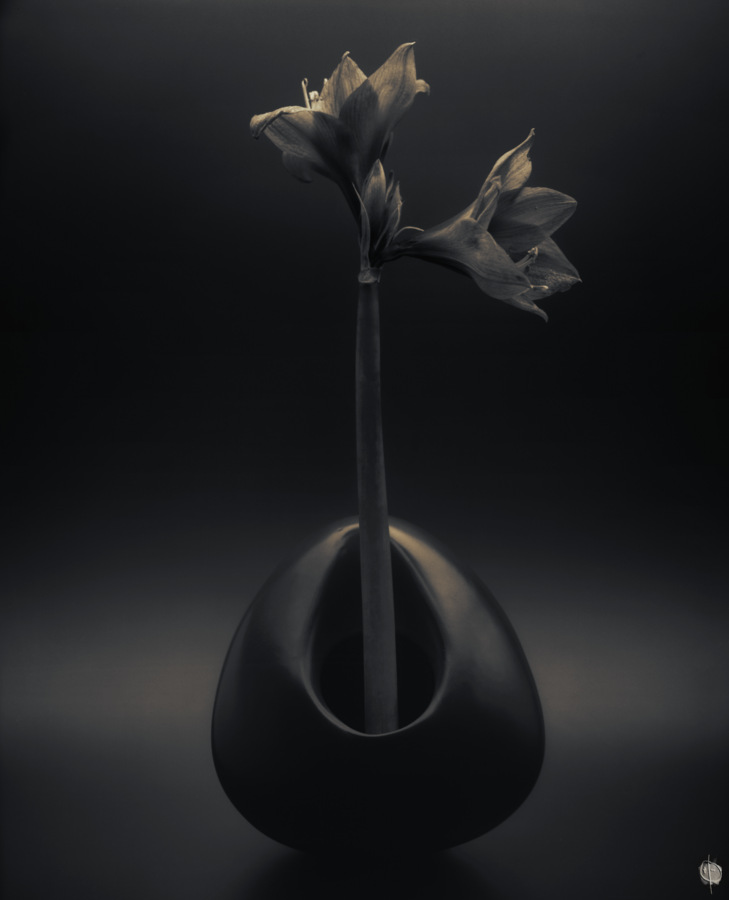
That vase had more in it than I expected. Turn it one way and it sat squat and wide under the flowers, grounded, heavy. Twist it slightly and the opening turned into this tall, dark column, with just a thin rim catching light. A stem could slide through cleanly, tip away, or fade almost completely against that darkness. Every small change created a new link between the vessel and what it held, and I kept stumbling into another one.

One arrangement, the one where the flowers lean to the side, carries a clear nod to Mapplethorpe. That image had stuck with me. I wanted my own version of that balance, the vase pulling weight on one end, the flowers reaching out on the other, the stems doing the quiet work of keeping it all in one piece.

But the session didn’t stay there. Some frames went in a different direction. One flower could take over the whole view. A taller setup could push the vase into near-black, like it was barely present. Once I paid attention, the little tabletop scene suddenly felt endless, plenty there to occupy an entire weekend without repeating myself.

Whenever an arrangement felt like it had landed, I’d move to the ground glass.

That shift mattered. Staring at the objects with my own eyes only got me so far. I can’t tilt my vision or slide it around the way I can with the camera’s front and rear standards. On the glass, those movements became visible, and I could judge what they actually did, not what I imagined they might do.

The setup might have been sitting right in front of me, finished in a way, yet I was still finding the photograph inside it.

So I’d adjust, check again, and go where the image led. The camera movements weren’t just technical steps, they were part of the searching. Only once that felt resolved did I settle on exposure.

When the discovery is done, that’s when the image arrives.

What I remember most is how smoothly one frame nudged me into the next. A familiar vase, a handful of flowers, and a camera that kept the door open for more looking. Every arrangement answered something, then left another question sitting there.

All I’d meant to do was play a little with a vase from the cupboard.

It ended up taking my whole weekend.